
 Jul 22, 2026


Choosing a 51.2V HESS battery supplier becomes easier when every quotation answers the same questions: how much energy is available, how much power the battery can support, which inverter configuration has been checked, and what the installation requires. A familiar voltage label is a useful starting point, but it does not establish those answers.
This guide compares 100Ah, 200Ah, 280Ah and 314Ah capacity classes for residential solar storage projects. It is written for distributors, solar brands and system integrators preparing an OEM purchase. The aim is to turn a broad request for a home energy storage system into a configuration that can be quoted, sampled and evaluated consistently.
Quick answer: at 51.2V nominal, the four capacity classes calculate to 5.12kWh, 10.24kWh, 14.336kWh and 16.0768kWh respectively. Select between them using required delivered energy, battery current limits, inverter requirements and installation constraints. These calculations are not promises of usable energy or backup duration.
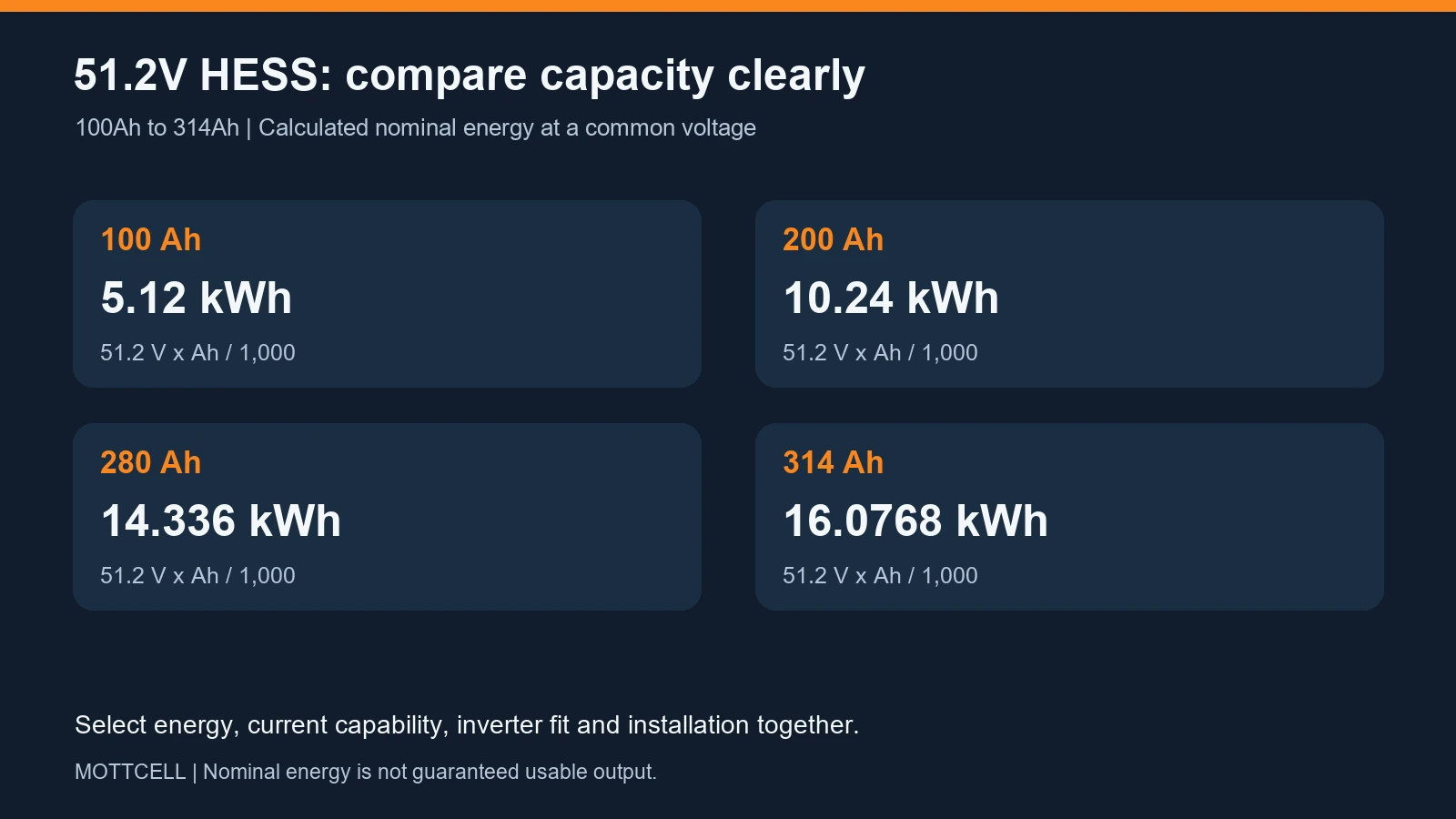
Capacity comparison based on voltage multiplied by ampere-hours. The diagram shows calculated nominal energy, not tested output or a particular product enclosure.
HESS is used here to mean a home energy storage system. The purchase may cover a battery module alone, a battery with a separately selected inverter, or an integrated all-in-one system. Make the boundary explicit. Two offers with a similar kWh label can include very different equipment, installation work and commissioning responsibilities.
A battery-only quotation should identify the electrical interface and the equipment supplied with the battery. An integrated-system quotation should also identify the inverter, AC connection, solar input arrangements and supported operating modes. Ask who confirms the combination and who investigates a problem when the battery and inverter report different states.
Start with the intended use: daily solar self-consumption, backup for selected household circuits, or a combination. Whole-building backup introduces additional load and switching requirements. A residential low-voltage battery should not be presented as an automatic solution for a factory production line simply because the buyer is an industrial company.
A conventional LiFePO4 cell is commonly described using a nominal voltage of 3.2V. Sixteen cells connected in series give 51.2V nominal; fifteen give 48.0V nominal. The term 16S identifies the series arrangement. It does not specify capacity, charging current, communication protocol or the complete system's AC output.
Suppliers also use “48V class” as a broader market category that can include 51.2V batteries. Consequently, a category label alone is not enough to establish compatibility. Record the exact model, nominal voltage, approved operating window and charging requirements in the quotation. Use the same model designation on the sample, specification and purchase order.
Nominal voltage is a reference value, not a regulated output. Battery terminal voltage varies with state of charge, current and operating conditions. The inverter must support the specified battery voltage range, and its control settings must match the battery requirements. Electrical range compatibility and communication compatibility are separate checks; one does not prove the other.
Ampere-hours describe charge capacity. For a common nominal voltage, multiplying volts by ampere-hours gives calculated nominal watt-hours. Divide by 1,000 for kilowatt-hours. This simple calculation provides a consistent comparison before differences in operating limits and system losses are considered.
| Capacity class | Calculated energy at 51.2V | Procurement question |
|---|---|---|
| 100Ah | 5.12kWh | Does the delivered energy cover the selected essential loads? |
| 200Ah | 10.24kWh | Does the current rating support the required inverter demand? |
| 280Ah | 14.336kWh | Does the installation accommodate the proposed enclosure? |
| 314Ah | 16.0768kWh | Is the additional usable capacity needed and documented? |
These are capacity classes for comparison, not a declaration that every supplier offers every configuration. Marketing labels such as 5kWh, 10kWh, 15kWh or 16kWh may group products approximately. Ask for the actual nominal energy, cell capacity and configuration rather than treating the rounded product name as an exact specification.
At the same 51.2V nominal voltage, moving from 280Ah to 314Ah adds 1.7408kWh of calculated nominal energy, or approximately 12.1%. That percentage does not prove higher energy density, longer service life or greater power. Those comparisons require the respective mass, dimensions, operating limits and supporting evidence.
Once the capacity class is selected, use a focused guide for the remaining detail: the 5kWh indoor modular battery guide covers smaller modules, while the 16kWh and 314Ah buying guide addresses the larger capacity class. This comparison remains the starting point for choosing between them.
Begin with the circuits that must operate during the chosen period. Record their power, operating hours and duty cycles. A router may run continuously, while a refrigerator cycles and a kettle runs briefly. Multiplying every nameplate rating by the full backup duration can produce an unrealistic energy estimate.
Use measured consumption where available. A circuit monitor or a suitable interval dataset can reveal the load pattern more clearly than a monthly electricity bill. A monthly total helps describe overall use but does not show simultaneous demand or how much energy is required during a particular evening or outage.
For a transparent planning example, suppose the selected loads average 0.75kW for six hours. They require 4.5kWh delivered to the loads. Assume, only for this example, that 80% of nominal battery energy is available for the duty and that conversion efficiency is 90%. Required nominal energy is 4.5 ÷ (0.80 × 0.90) = 6.25kWh.
On those assumptions, a 5.12kWh nominal battery falls below the energy requirement, while a 10.24kWh class passes the initial energy screen. That is not a finished system selection. Standby consumption, temperature effects, aging allowance, starting demand and the exact usable-energy specification still need to be checked. Replace the example factors with approved project values.
Avoid counting the same reserve twice. If a supplier's usable-energy figure already excludes a reserve, do not apply that identical reserve again without a reason. Conversely, a nominal-energy number should not be treated as fully available. Write down which losses and reserves are included at each stage so another reviewer can reproduce the calculation.
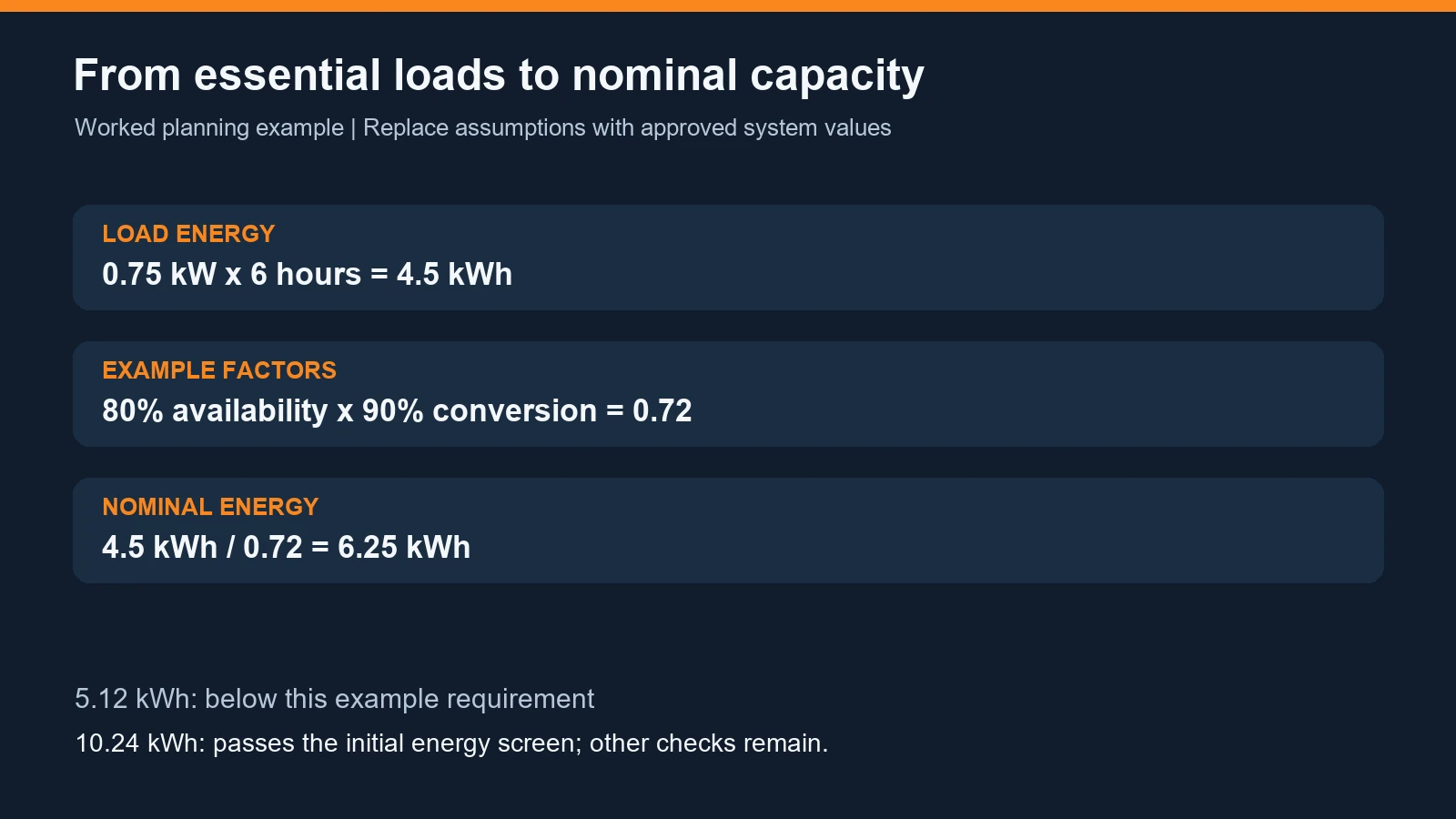
Illustrative energy calculation using 80% availability and 90% conversion efficiency. Replace both assumptions with the selected system's verified values.
A larger Ah number increases stored charge but does not automatically raise permitted discharge current. A 200Ah battery and a 100Ah battery may have similar current limits, depending on their design. Compare continuous current, any permitted short-duration current, the relevant duration and the operating conditions for each model.
For an indicative calculation, 5kW of AC demand at 90% inverter efficiency requires about 5.56kW from the battery before other losses. Dividing by 51.2V gives approximately 108.5A. Actual current rises if the battery voltage falls while power remains similar. Therefore, a nominal-voltage calculation should not be used to approve a current limit at the bottom of the operating window.
Motor starting and other brief demands also deserve separate review. Ask how the inverter handles the load and how the battery's protection responds. A short-duration rating without its time limit is incomplete. For model-pairing questions, the 48V-class 200Ah inverter-fit guide explains the information to collect before compatibility is accepted.
Mottcell's home energy storage product page lists the SMJ 5KWh T01 with 100Ah, the SMJ10KWh T01 with 200Ah and the SMJ 15KWh T01 with 280/314Ah variants. The published table describes 16S configurations. These entries help identify a product discussion; they do not replace the specification for the final supplied variant.
Ask the quotation to identify which 280Ah or 314Ah version is proposed, the rated energy, current limits, dimensions and included accessories. A family-level table can contain alternatives or abbreviated notation. Resolve unclear entries in writing instead of silently converting them into a firm engineering requirement.
If the project needs an inverter and battery in one integrated design, compare the separate all-in-one energy storage range. Check the complete system's output and input specifications. A battery capacity shared with another model does not imply the same inverter, mounting arrangement or commissioning procedure.
Buyers searching for a smart 51.2V HESS often need useful monitoring and coordinated operation, rather than a feature label. Translate that request into functions: state-of-charge reporting, charge and discharge limit communication, fault reporting, event records and the operator's ability to understand a protective shutdown.
A CAN or RS485 connector describes an interface, not universal interoperability. Ask for the supported inverter model, firmware versions, communication settings and the tested configuration. Clarify which device controls charging limits, how the system responds when communication is lost, and which settings are locked or adjustable by the installer.
For an example of this documentation approach, Victron's control guidance directs users to battery-specific compatibility information and firmware requirements. It illustrates why integration needs configuration-level evidence; it does not establish compatibility for a Mottcell battery.
Evaluate efficiency claims at the same measurement boundary. Battery DC energy, inverter conversion efficiency and full-system AC round-trip efficiency describe different quantities. Ask how a quoted figure was measured, including power level and standby consumption. Without comparable test conditions, a single efficiency percentage is a poor basis for ranking suppliers.
Storage capacity and solar generation should be considered together. A larger battery is not necessarily filled on a typical day if the available solar surplus is small. Compare generation, household consumption and charging opportunities across the expected season. A clear operating objective makes the sizing discussion more useful than simply selecting the largest enclosure.
For a rough scheduling example, restoring 8kWh to a battery at a constant 2kW net charging rate takes four hours before allowing for charging behavior near the limits. Real charging power varies with solar conditions, competing loads and control limits. Treat the calculation as an energy balance, not a promised recharge time.
Document whether the project prioritizes self-consumption, a backup reserve or time-based operation. These priorities can conflict: keeping more energy reserved for an outage leaves less available for routine evening use. The agreed control settings should reflect the customer's purpose and the equipment's supported behavior rather than an assumed default.
Request a dimensioned drawing and the selected model's installation instructions. Check the proposed location, mounting method, access for service, cable routing, connectors and environmental limits. A photograph that shows a neat cabinet does not establish its suitability for a damp, hot or exposed location.
Parallel expansion must follow the approved architecture. Confirm supported module combinations, the maximum configuration, communication arrangement and how new modules are introduced. Do not assume that different capacities, ages or firmware versions can be mixed just because their nominal voltages match. Expansion can change current distribution and the requirements for external equipment.
Think about replacement as well as initial installation. Ask which service tasks can be performed locally, what information identifies the installed revision and whether the supplier needs a diagnostic record before authorizing a replacement. Keep the installation and commissioning records associated with the exact equipment shipped to the customer.
Supplier evaluation should connect documents to the configuration being purchased. A company certificate or a report for a related product does not establish every attribute of the proposed battery. Request relevant model-specific documents and check that the model name, revision and scope match the order.
For a sample, agree on the evaluation conditions before testing begins. Useful items include identification checks, dimensions, delivered energy under a defined load, operation with the selected inverter, communication and recovery from the states described in the manufacturer's procedure. Acceptance criteria should be measurable and mutually understood.
Keep the evaluation within the approved operating instructions. Fault simulation and protective-function testing belong in a suitable test environment under a competent test plan, not an improvised installation. An acceptance record should include equipment versions, configuration, conditions, observations and unresolved questions so the production order does not depend on memory.
| Review item | Evidence to request | What to resolve |
|---|---|---|
| Energy | Nominal and usable energy with conditions | Whether the duty and reserve are covered |
| Power | Continuous and time-limited current ratings | Demand at the relevant voltage and temperature |
| Integration | Model and firmware pairing record | Control behavior and communication settings |
| Installation | Drawing and installation instructions | Location, access and equipment scope |
| Supply | Approved sample and revision record | Production consistency and change notification |
Prepare one project brief and send the same version to each supplier. Include the target market, residential application, desired battery format, selected loads, energy requirement and inverter information. Add installation constraints, expected sample quantity, intended order volume and the evidence required for the project.
Ask the supplier to separate confirmed specifications from optional features and items awaiting validation. Clarify what the price includes: battery, communication cables, mounting parts, inverter if applicable, packaging and support. Compare warranty scope and service arrangements using the same duty assumptions; a longer headline term does not alone establish better project value.
Before a repeat order, record how changes to cells, BMS hardware, firmware or enclosure details will be communicated and approved. The configuration validated during sampling should be identifiable in production. This provides a practical basis for discussing alternatives if a component changes without assuming that all revisions behave identically.
Compare the alternatives over the same purchasing boundary. A price per nominal kWh can help organize quotations, but it leaves out usable-energy limits, installation items and service scope. If one offer includes an inverter and another supplies only a battery, their unit prices are not directly comparable. Make a short list of included and excluded items before calculating any unit-cost comparison.
For example, a household that rarely needs the additional capacity may gain little practical benefit from a larger module if its solar surplus and evening demand remain small. Another household may value the same extra energy because its essential-load period is longer. The useful comparison is the fit to the duty, with the cost of the complete approved configuration, rather than the largest advertised capacity.
For projects considering the 280Ah and 314Ah classes, the 15kWh-class home backup guide develops the runtime discussion further. Bring the resulting load estimate back into the quotation brief so the selected capacity, inverter and reserve settings remain consistent.
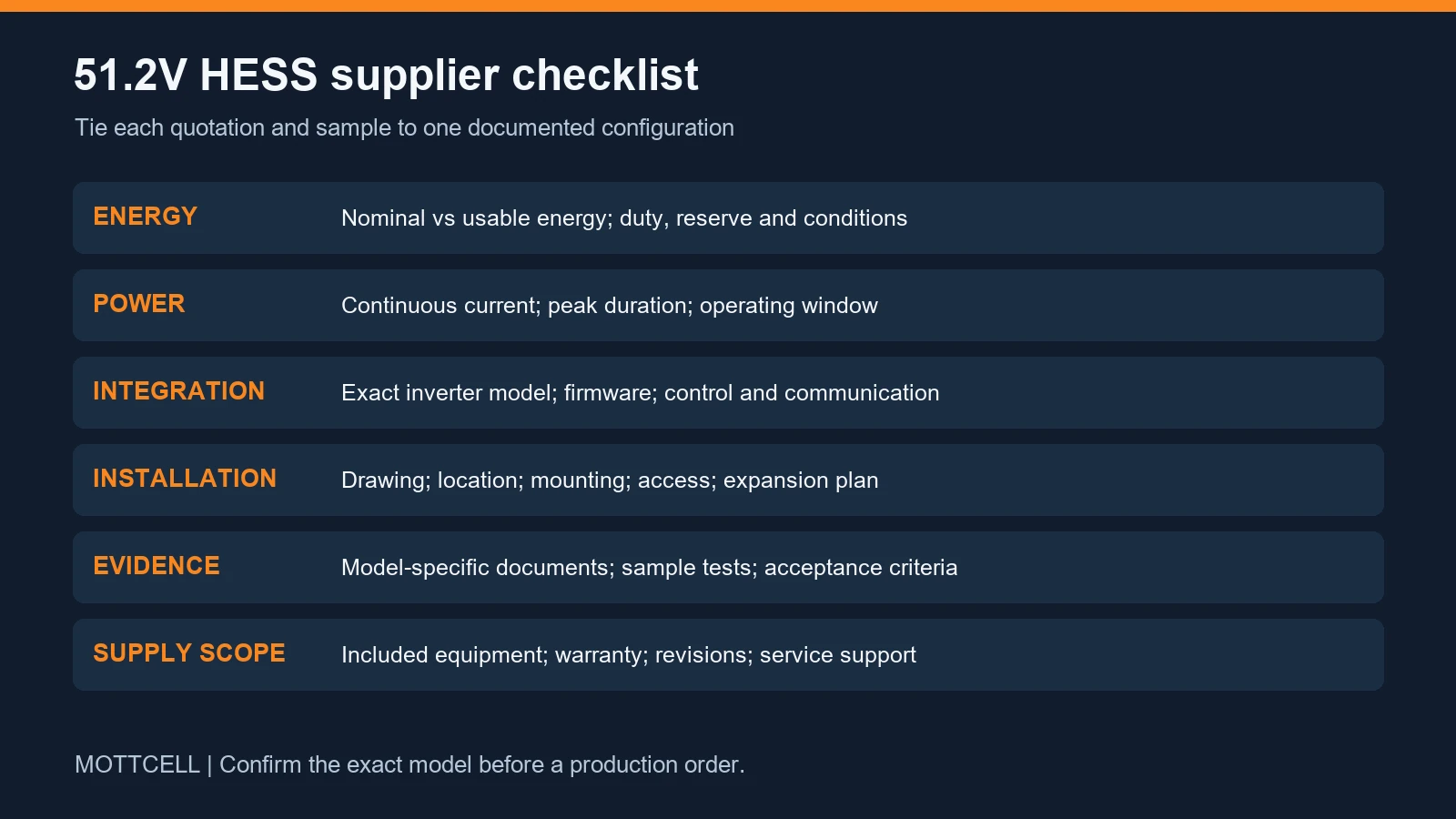
Use one project brief to compare quotations and to keep sample acceptance tied to the supplied configuration.
Not necessarily. A 16S LiFePO4 configuration is 51.2V nominal, while 15S is 48.0V nominal. Both may appear in a 48V product category. Confirm the actual model, operating window, charging settings and integration requirements.
At 51.2V they calculate to 5.12, 10.24, 14.336 and 16.0768kWh of nominal energy. Start with the required delivered energy and reserve, then check current capability, inverter requirements and installation constraints. Capacity alone is insufficient.
No. Voltage range is only one condition. Confirm current limits, charging control, supported communication and the exact model and firmware combination. Keep the approved settings and sample results with the project record.
Next step: send Mottcell your 51.2V HESS project brief to discuss a model-specific quotation. Include the selected loads, required duration, inverter details and installation constraints so the proposed capacity can be evaluated against the actual duty.
Editorial basis: Mottcell's published product information and explicit engineering calculations for procurement planning. The examples are not customer case studies or measured product results. Confirm final ratings and supplied equipment against the approved model documentation.
48V 300Ah HESS Supplier: Voltage, Runtime and OEM Guide
48V 100Ah HESS Supplier: 5.12kWh Solar OEM Buying Guide
12.8V 200Ah Battery Pack Factory: OEM Sourcing Guide
Commercial HESS Supplier: Factory Microgrid Sizing Guide
51.2V HESS Battery Supplier: 100Ah to 314Ah Capacity Guide
12V LiFePO4 Battery Pack Manufacturer: 50Ah-314Ah OEM Guide
16kWh HESS Supplier: 51.2V 314Ah Buyer’s Guide
5kWh HESS Supplier: Indoor Modular Battery Buying Guide
Established in 2005
In 2009, it was awarded the title of "National High tech Enterprise"
 zoe@mottcell.net
WhatsApp: 8617388790296
Fax: 86-0755-84042963
Skype: live:b0ebaecbb8782516
WeChat: +8613428749632

 VR show
 CN
CN Home >


