
 Jul 18, 2026


A buyer searching for a 48V 100Ah HESS supplier usually needs more than a battery labeled “48V.” The procurement decision has to connect a real battery configuration with an inverter, an installation environment, a target market and a service plan. A short product listing rarely answers all four questions. This guide is for distributors, solar installers and OEM procurement teams evaluating a 100Ah low-voltage battery for residential or light commercial energy storage.
Mottcell's published range provides two useful starting points. Its energy storage battery range lists the SMG48100, a 100Ah, 16-series battery with 5,120Wh of stated energy and dimensions of 523 × 269 × 222mm. Its home energy storage system range lists the SMJ 5KWh T01, a 100Ah, 16-series software-BMS system with a sheet-metal enclosure and published dimensions of 390 × 700 × 154/185mm. These are distinct products in different housings. The published pages are a starting point for a quotation; a buyer still needs the current model datasheet, configuration drawing and application-specific confirmation.
The most important early distinction is that 48V-class is a market category, while the actual nominal voltage of a 16S lithium iron phosphate configuration is 51.2V. The difference affects energy calculations and the questions asked of an inverter supplier. It does not make an inverter compatible by itself. The sections below show how to specify the battery, check system fit and request comparable offers without treating marketing language as engineering evidence.

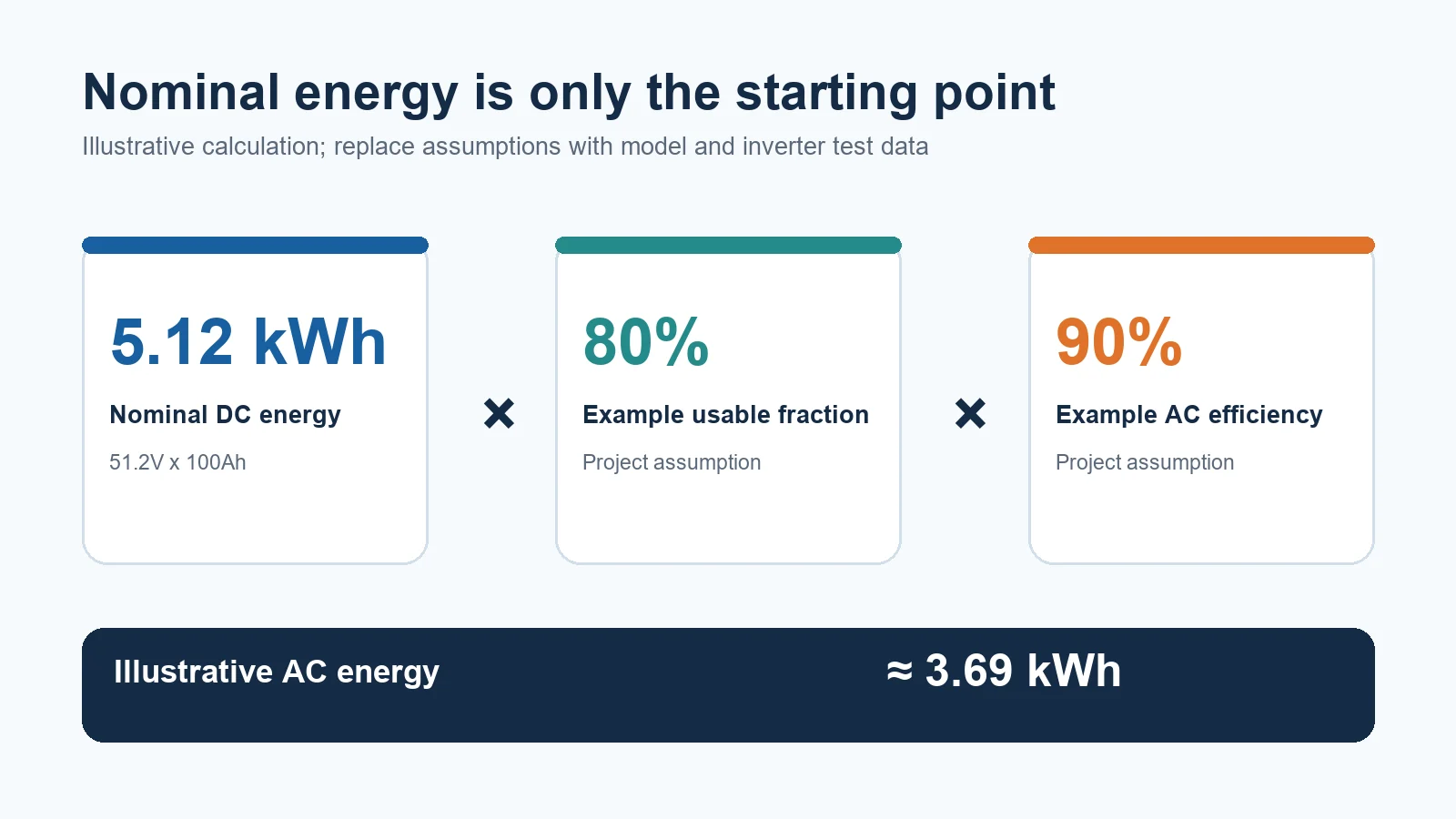
Amp-hours describe charge capacity. Energy in watt-hours also depends on nominal voltage. For a 16S LiFePO4 battery, a nominal 3.2V per cell gives 51.2V at the pack level. Multiplying 51.2V by 100Ah gives 5,120Wh, or 5.12kWh of calculated nominal DC energy. This aligns with the SMG48100's published 5,120Wh figure. The calculation is useful for comparing product categories, but it does not equal guaranteed AC output or usable energy at a chosen discharge limit.
A different, hypothetical 15S LiFePO4 pack would be 48.0V nominal and would calculate to 4.80kWh at 100Ah. Do not assume the quoted product is 15S just because a search result says “48V.” Conversely, do not assume that every product marketed for a 48V inverter is a 16S battery. Ask for the exact series count and approved operating voltage window in the model-specific document. The published Mottcell SMG48100 and SMJ 5KWh T01 entries identify 16S configurations; this guide does not present a Mottcell 15S 100Ah model as an available product.
Usable energy depends on permitted state-of-charge range, load current, temperature and the complete system. AC output also reflects inverter losses and auxiliary consumption. As a planning illustration only, if a project chose an 80% usable fraction and assumed 90% conversion efficiency, 5.12 × 0.80 × 0.90 would be about 3.69kWh delivered at the AC side before other losses. A 1kW constant load would then have a theoretical 3.69-hour duration. Neither percentage is a published SMG48100 rating. A quotation should replace these assumptions with approved model and inverter test data before a backup-time promise is made to a customer.
| Item | Published or calculated value | How a buyer should use it |
|---|---|---|
| SMG48100 capacity | 100Ah on Mottcell's energy storage battery page | Confirm the current model revision in the quotation. |
| SMG48100 configuration | 16S on the published table | Request the nominal and operating voltage limits for that revision. |
| SMG48100 stated energy | 5,120Wh on the published table | Treat it as nominal battery energy, not guaranteed usable AC energy. |
| SMG48100 dimensions | 523 × 269 × 222mm on the published table | Check drawing tolerances, terminals, mounting clearances and packaging. |
| SMJ 5KWh T01 | 100Ah and 16S software BMS on the home ESS page | Compare the complete housing and system scope separately from SMG48100. |
| 15S, 48.0V example | 48.0 × 100 = 4.80kWh, a calculation | A voltage-class example only; no Mottcell 15S model is claimed here. |
“HESS” can describe a battery module, a packaged home storage battery, or an integrated system that also contains power conversion equipment. Suppliers may quote different scopes under the same capacity keyword. Ask each bidder to state exactly what is included: battery, BMS, enclosure, fuses or disconnects, cables, inverter, monitoring hardware and installation accessories. A lower price for a bare battery should not be compared directly with a complete all-in-one cabinet.
The SMG48100 belongs to Mottcell's energy storage battery range. The SMJ 5KWh T01 appears in its home energy storage system range. Their published dimensions and enclosure descriptions differ. A buyer should not merge values from the two tables into a fictional single SKU. If a customer wants an integrated inverter and battery rather than a separate battery, review Mottcell's all-in-one energy storage system category and request a complete system specification. If the site requires a different enclosure or configuration, the customized energy storage category is a route to discuss feasibility, not proof that any requested design is already qualified.
For a small residential solar project, the battery may be selected around an existing compatible inverter and essential-load circuit. A light commercial site may need a different design review, electrical protection scheme and installation approval. A 5.12kWh nominal battery should not be presented as a complete solution for factory-wide outage protection. The load profile and power rating determine whether the proposed battery and inverter can serve the intended loads. Energy capacity answers “how long” only after the power and usable-energy questions are addressed.
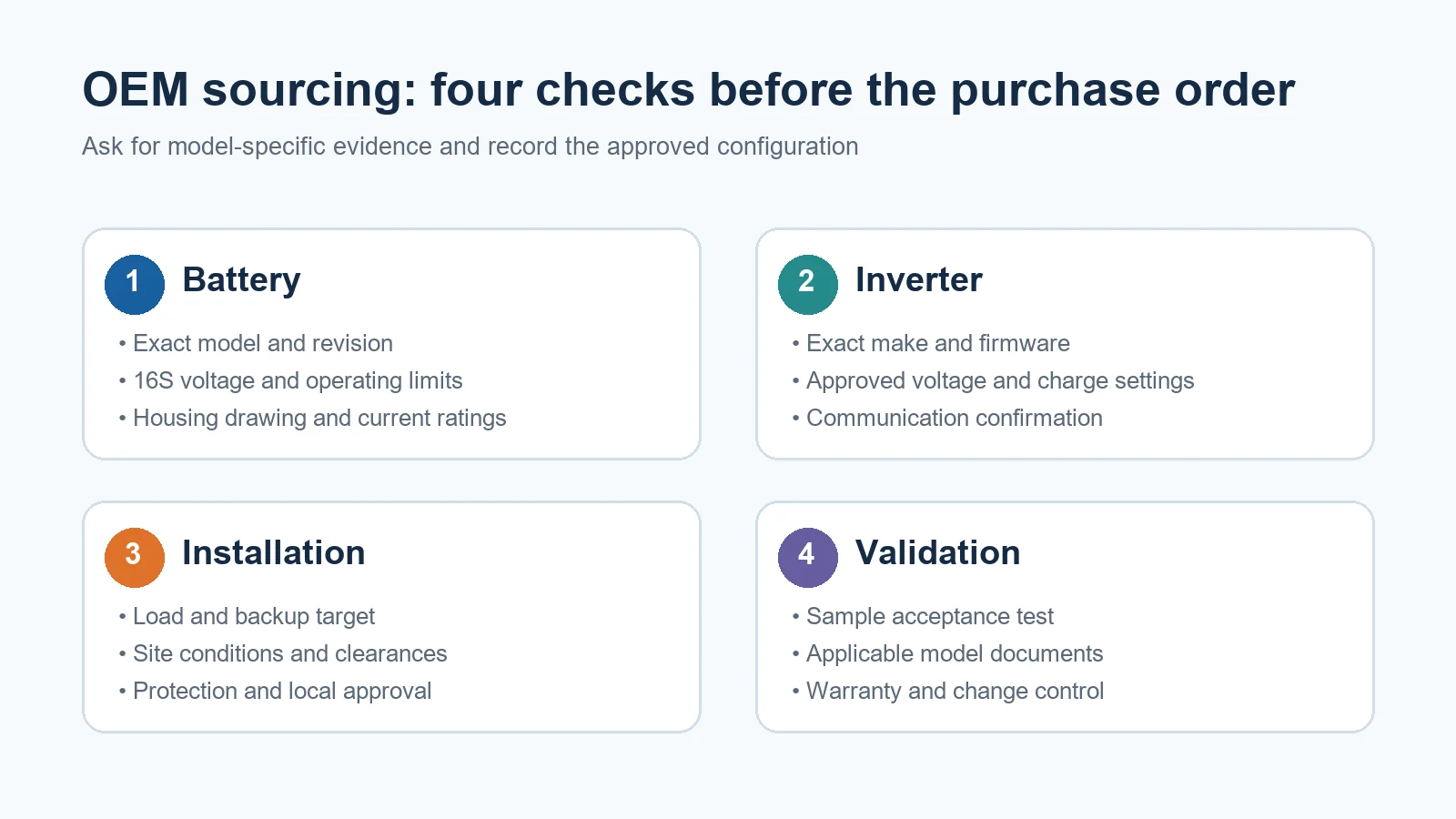
The first compatibility check is electrical. Obtain the inverter make, model, hardware and firmware revision, DC battery-voltage range, charging voltage settings, charge and discharge current limits, and any approved battery list. Then obtain the battery's corresponding model-specific voltage limits and BMS operating limits. The nominal 51.2V label alone cannot validate an inverter's charge algorithm or its behavior near the battery's upper and lower cutoffs.
The second check is communication. Some integrations use a specified CAN or RS485 protocol, while others run in an approved voltage-controlled mode. A connector that physically fits does not guarantee a compatible message map. Ask both vendors for a written compatibility statement for the exact battery revision and inverter firmware. If the proposed design depends on remote monitoring or coordinated state-of-charge reporting, include those functions in the acceptance test. This is particularly important for an OEM that will support many installations after the initial sample succeeds.
The third check is system power. The published SMG48100 table includes current entries, but a table alone does not establish continuous AC power for a particular installation. Cable sizing, protection devices, inverter limits, ambient conditions and battery operating limits all matter. Have a qualified designer review the complete system and local rules. Keep a signed configuration sheet recording the approved battery, inverter and settings; otherwise the production purchase order may differ from the validated sample.
A useful test plan includes start-up and shutdown, normal charging, a representative load, low-state-of-charge behavior, loss and restoration of grid power, any intended monitoring functions, and fault indications. Record settings, firmware and ambient conditions. These are acceptance-test topics, not claims that Mottcell has already tested every proposed inverter pair. Where the buyer plans to connect multiple batteries, obtain the model-specific parallel wiring, protection and control instructions. Do not infer a permissible parallel count from another product or a marketing article.
A 100Ah unit may suit a limited backup load, a compact installation or a pilot project. Larger capacity can reduce the number of separately installed batteries for a higher energy requirement, but it may require a different enclosure, handling plan and electrical design. Mottcell's home ESS page lists 100Ah, 200Ah, 280/314Ah and 560/628Ah entries across the SMJ range. Those are different catalog configurations; they do not establish that a 100Ah unit can be expanded to every larger size by changing cells alone.
For a project that needs roughly twice the nominal energy, compare the 48V-class 200Ah HESS buying guide with the current 100Ah quote. For a broader capacity comparison, see the 51.2V HESS battery guide. The specific purchase choice should be based on the required daily energy, backup window, charge opportunity, allowable installation space and approved equipment combination. Search volume or a round kWh label cannot substitute for that design work.
For example, suppose a site has an essential 600W load and wants four hours of autonomy. The AC load energy is 2.4kWh before reserve, inverter losses and any start-up peaks. A 5.12kWh nominal battery could be a candidate for further engineering review, but the answer remains conditional on approved usable energy, inverter power, temperature and the actual load profile. If the load includes a pump or motor, the start-up surge may drive the inverter selection even when total kWh seems modest. The procurement brief should therefore include both energy and peak power.
If a facility needs tens or hundreds of kilowatt-hours, compare a properly scoped commercial and industrial ESS product range and the commercial HESS sizing guide. A small low-voltage home battery is not automatically a substitute for a commercial cabinet. The larger project has different safety, grid-connection, controls and service requirements. Keeping these application boundaries clear also helps a B2B buyer obtain quotations that are comparable.
An enclosure that fits on a drawing may still be unsuitable for the actual site. State whether the battery will be indoors, in a protected utility room, in a ventilated cabinet or in another environment. Provide the available footprint, service clearances, mounting surface and cable-routing path. For the SMG48100, the published table gives dimensions, but the final drawing must also identify terminal position, access, mounting method and any required clearances. If a buyer wants a wall-mounted or floor-standing home ESS, request the current SMJ housing drawing separately.
Ask for the permitted ambient temperature and humidity range, storage conditions, ingress protection for the specific supplied enclosure, and restrictions on direct sun, water or corrosive exposure. The publicly available category pages do not justify assigning an IP rating to every 100Ah variant. Likewise, do not equate a housing material entry with a complete safety assessment. Site-specific fire separation, ventilation, access and electrical protection require the local designer or authority to review the proposed installation.
Handling and service access matter for distributors. Request the packed and unpacked weights, carton dimensions, lifting method and spare-parts approach. The prior version of this page claimed a 42kg pack and effortless single-person hot-swapping; neither statement should be used without a model-specific source and an approved service procedure. A practical quotation can include a service drawing and a written replacement sequence instead of promising a feature that has not been demonstrated.
A credible supplier assessment is more than a factory story. Ask for a current datasheet tied to the exact model code, an electrical schematic or interface drawing at the level appropriate for evaluation, a dimensioned outline, and the installation and operating instructions. Confirm which document revision controls the quotation. If the project requires a product certification or transport document, ask for the report or certificate and check the model coverage, issuing body, jurisdiction and validity. A company-level certification should not be represented as certification of every battery design.
Request a test plan for the sample and the production acceptance criteria. Relevant subjects may include capacity at specified conditions, insulation and protection checks, BMS cutoff behavior, communications with the selected inverter and physical inspection. The actual test conditions and passing limits should be written into the agreed specification. A claim such as “thousands of cycles” has little commercial meaning without a defined depth of discharge, temperature, current, end-of-life threshold and test method. The same applies to broad claims about zero maintenance or guaranteed return on investment.
For repeat OEM orders, ask how the supplier identifies model revisions, tracks batches and approves substitutions. Agree how packaging, labels, manuals and software revisions will be controlled. If a sample is approved with one inverter firmware or BMS setting, a later change should trigger a documented compatibility review. This process protects distributors and installers from field variations that are hard to diagnose after shipment. Ask how warranty claims are logged, what evidence is required and where service responsibility sits across supplier, integrator and local installer.
Mottcell describes battery PACK and system integration capabilities on its About Us page. Treat company information as background for supplier qualification. Make the award decision from the current offer, documents, sample results and contract terms for the particular model. If you need manufacturing details, request a facility review or a meeting with the engineering team. This is more reliable than importing unverified statements from an older blog post into a procurement specification.
The cheapest line item may omit cables, monitoring, freight, testing or support. Send all prospective suppliers the same requirement sheet and ask them to identify inclusions and exclusions. Separate a battery-only quote from a complete system quote. Specify the target country, annual volume, sample quantity, delivery terms, lead time assumptions and required documentation. Ask how the price changes with enclosure, connector, branding, packaging and firmware options. If an option is not yet engineered, price and schedule it as a feasibility step rather than treating it as standard stock.
| RFQ field | Information to supply | Evidence to request back |
|---|---|---|
| Application and load | Residential solar backup, light commercial load or other clearly defined use; daily kWh, peak W and backup hours | Proposed product boundary and sizing assumptions |
| Battery choice | 100Ah 48V-class target and preferred enclosure | Exact model code, current datasheet and revision |
| Inverter | Make, model, firmware and communication requirement | Written compatibility and approved settings |
| Site | Indoor/outdoor location, temperature, dimensions and mounting | Enclosure drawing, permitted environment and installation manual |
| Compliance | Destination country and required standards | Model-specific reports or certificates with scope and dates |
| Commercial terms | Sample and forecast volume, delivery point, branding and warranty expectation | Itemized inclusions, lead time, change control and warranty terms |
When comparing offers, distinguish one-time qualification work from recurring unit cost. A customized housing may require engineering, tooling, a new test plan and additional validation. A catalog model may reach a pilot installation sooner if it already meets the site requirements. Neither path is automatically cheaper over the whole program. Build a simple comparison of purchase price, approved system components, freight, installation work, service process and any required verification. Populate the figures from actual quotes and site data rather than a generic “cost-effective” promise.
If a buyer hopes to use multiple 100Ah units, request the complete design before treating unit prices as a system price. The quote should identify the permitted number of units, connection architecture, protection, communications, monitoring and installation labor. A larger single enclosure may be preferable for some sites; separate modules may suit others. The answer is an engineering and commercial comparison, not an assumed universal advantage of modularity.
Start with the load and site survey. Record measured energy use where available, the critical circuits, expected backup duration and any start-up surge. Next, select the battery and inverter candidates from current datasheets. Confirm nominal voltage, operating limits, current, physical fit and required communications. Then obtain a written supplier proposal with identified model revisions. This prevents a marketing keyword from becoming an unreviewed purchase specification.
Run a sample validation that reproduces the planned installation as closely as practical. Document the inverter settings, wiring, ambient conditions and observed charge/discharge behavior. If a local electrical designer or authority must approve the system, include that review before committing to volume. Resolve mismatches in documents and test results while the project is still small. The supplier, distributor and installer should agree who approves a revised battery or firmware version after the pilot.
For volume orders, convert the successful pilot into controlled acceptance criteria. Retain the approved drawings, bill of materials where appropriate, test records, label artwork and packing standard. Identify the change-notification process. This is the stage at which a supplier's documentation quality becomes commercially valuable: it allows the buyer to repeat a known configuration, investigate issues and support downstream customers with a clear record.
No. “48V” is often used as a broad low-voltage category. A hypothetical 15S LiFePO4 100Ah pack calculates to 4.80kWh nominal, while the published Mottcell SMG48100 is 16S and lists 5,120Wh, consistent with 51.2V × 100Ah. Confirm the actual model and nominal voltage before comparing energy figures. Neither number alone specifies usable AC energy.
No universal compatibility can be inferred from the voltage-class label. Compare the inverter's battery-voltage and current ranges with the approved battery limits, then verify charging settings and the communication method for the exact model and firmware. Request written confirmation and test the planned combination before deployment. If batteries will be paralleled, obtain the specific approved design and limits.
Request a model-specific datasheet, dimensions and terminal drawing, BMS and electrical limits, installation instructions, inverter compatibility evidence, sample test criteria, applicable model-specific compliance documents and a written warranty. Provide the destination market, application, load profile, expected volume and required customization. Ask the supplier to identify which facts are already validated and which need engineering review.
A 100Ah low-voltage battery is a useful starting point for solar storage sourcing when its real configuration fits the project. Mottcell's published SMG48100 and SMJ 5KWh T01 listings provide concrete 16S, 100Ah references, while the final selection still depends on the chosen inverter, installation and acceptance criteria. Send the requirement sheet above to Mottcell's enquiry team and ask for the latest model-specific documents and a clearly scoped quotation.
48V 300Ah HESS Supplier: Voltage, Runtime and OEM Guide
48V 100Ah HESS Supplier: 5.12kWh Solar OEM Buying Guide
12.8V 200Ah Battery Pack Factory: OEM Sourcing Guide
Commercial HESS Supplier: Factory Microgrid Sizing Guide
51.2V HESS Battery Supplier: 100Ah to 314Ah Capacity Guide
12V LiFePO4 Battery Pack Manufacturer: 50Ah-314Ah OEM Guide
16kWh HESS Supplier: 51.2V 314Ah Buyer’s Guide
5kWh HESS Supplier: Indoor Modular Battery Buying Guide
Established in 2005
In 2009, it was awarded the title of "National High tech Enterprise"
 zoe@mottcell.net
WhatsApp: 8617388790296
Fax: 86-0755-84042963
Skype: live:b0ebaecbb8782516
WeChat: +8613428749632

 VR show
 CN
CN Home >


