
 Jul 09, 2026


Choosing a 48V 300Ah HESS supplier starts with a practical question: what battery configuration will actually arrive, and can your solar inverter use it? A purchasing label does not establish nominal voltage, usable energy, discharge power, or communication compatibility. Before comparing quotations, obtain a model-specific specification that connects all four.
This guide helps solar distributors, OEM brands, installers, and system integrators turn a 300Ah battery requirement into a clear request for quotation. It explains the difference between 48.0V and 51.2V, shows transparent energy and runtime calculations, and provides a checklist for sample approval. Calculations are illustrative planning examples, not performance tests or guarantees for a Mottcell model.
One important product distinction comes first. The current Mottcell home energy storage table lists the SMJ 15KWh T01 with 280Ah/314Ah options, rather than an explicitly listed 300Ah option. Buyers who need exactly 300Ah should request a written configuration proposal. Do not substitute a nearby capacity without approval, and do not treat a 15kWh category name as a complete specification.
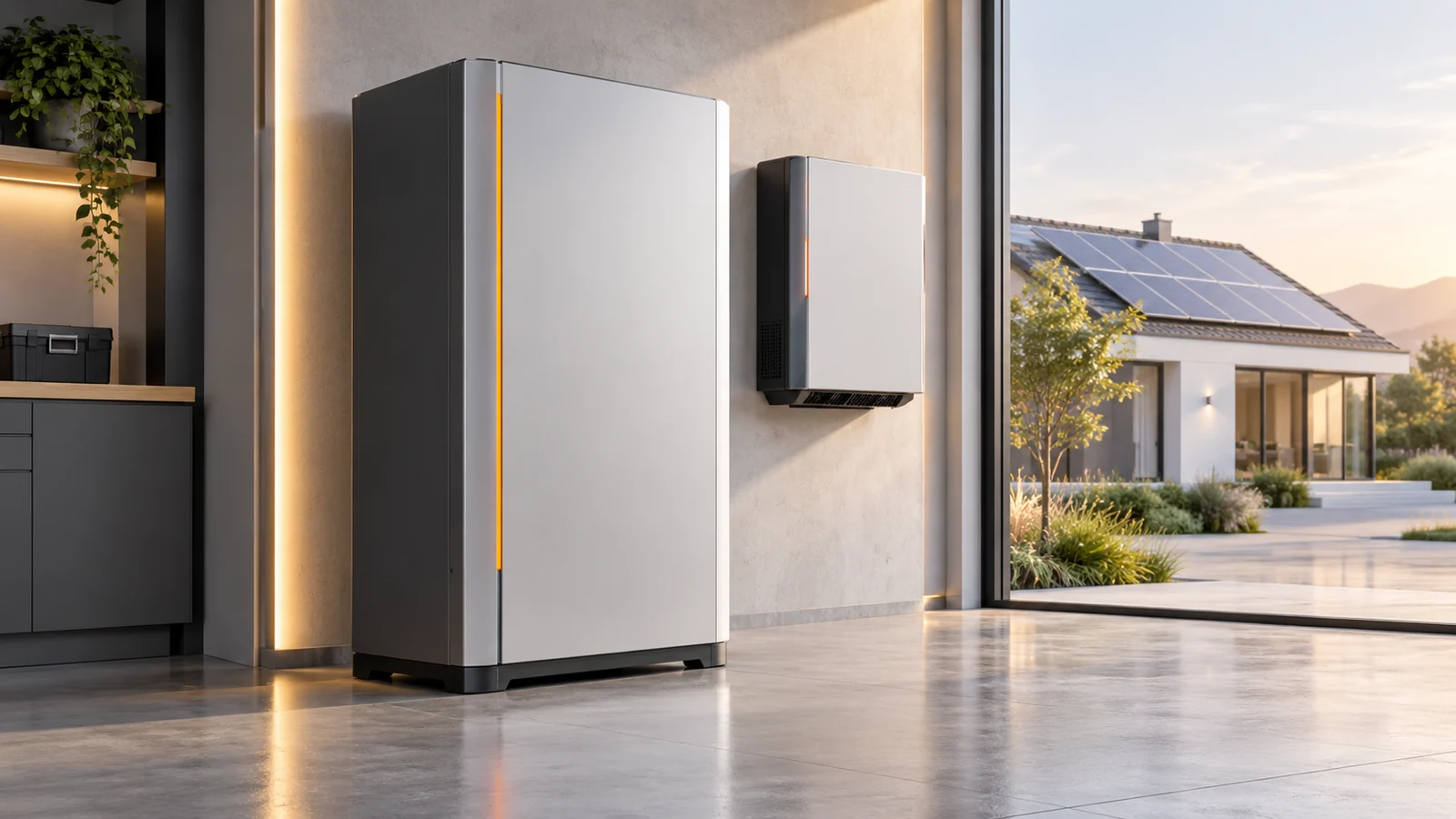
AI-generated concept illustration, not a photograph or specification of a supplied Mottcell product.
In this guide, HESS means home energy storage system. A business buying HESS may be an equipment factory, solar brand, or residential installation company; that does not make the final installation an industrial production line. Start with the intended application and the equipment boundary. A battery pack, a battery cabinet with controls, and an all-in-one system containing an inverter are different purchasing scopes.
Write the requirement in three parts: the battery configuration, the connected inverter, and the supported loads. For example, a project might require a low-voltage battery for an existing hybrid inverter and a selected household backup circuit. That statement is much more useful than requesting a generic industrial energy solution. It gives the supplier a basis for reviewing current, communication, enclosure, and operating conditions.
The term 48V is often used as a platform description. The actual nominal pack voltage must still be confirmed. A LiFePO4 configuration using sixteen nominal 3.2V cells in series has a nominal voltage of 51.2V. A fifteen-cell arrangement has a nominal voltage of 48.0V. This arithmetic explains the labels; it does not establish that either arrangement is available in a particular catalog model.
Similarly, 300Ah is charge capacity under defined test conditions. It does not tell you how much AC energy will reach the load, how quickly that energy can be delivered, or whether the battery can start a particular appliance. Ask the supplier to identify the exact model, cell arrangement, capacity test method, voltage limits, and approved operating conditions on one revision-controlled document.
Nominal energy in kilowatt-hours is calculated as nominal voltage multiplied by ampere-hours, divided by 1,000. Therefore, 48.0V × 300Ah ÷ 1,000 equals 14.40kWh, while 51.2V × 300Ah ÷ 1,000 equals 15.36kWh. The 0.96kWh difference follows from voltage; it is not an efficiency improvement or additional energy created by a BMS.
Use the following table to compare configurations on a consistent mathematical basis. Except for the noted capacity options, these rows are calculations rather than a list of confirmed Mottcell SKUs. Confirm actual nominal voltage and series configuration in the quotation before adopting any row as a product requirement.
| Configuration used for calculation | Nominal energy | Procurement interpretation |
|---|---|---|
| 48.0V × 300Ah | 14.40kWh | An exact 300Ah request still needs a confirmed model and voltage range |
| 51.2V × 300Ah | 15.36kWh | A different nominal voltage at the same Ah capacity |
| 51.2V × 280Ah | 14.336kWh | Illustrates one capacity listed for SMJ 15KWh T01; confirm voltage on the approved specification |
| 51.2V × 314Ah | 16.0768kWh | Illustrates the other listed capacity; it is not interchangeable with 300Ah without approval |
The Mottcell home energy storage system range provides the product reference behind the 280Ah/314Ah distinction. Its published SMJ 15KWh T01 row also lists a 16S software BMS, a sheet-metal housing, and dimensions of 850 × 450 × 250mm. Treat the website as a starting reference, then request the current drawing and signed specification for the offered version before designing an installation around it.
If your purchasing specification allows a capacity range, state the acceptable minimum energy and installation limits instead of silently changing the requested Ah value. If a customer tender requires exactly 300Ah, identify that as a mandatory condition. This prevents a technically reasonable alternative from becoming an unapproved commercial substitution later in the project.
Nominal stored energy is a reference value. The energy available to an AC load depends on the allowed operating window, inverter losses, battery condition, temperature, standby consumption, and the load profile. A supplier quotation should separate nominal DC energy from any guaranteed usable energy and explain the conditions behind the latter.
For an initial estimate, use: illustrative AC energy = nominal DC energy × assumed usable fraction × assumed conversion efficiency. Suppose a hypothetical 51.2V 300Ah configuration provides 15.36kWh nominal energy. With an assumed 80% usable fraction and an assumed 90% conversion efficiency, the result is 11.0592kWh, or approximately 11.06kWh. These percentages are planning assumptions, not published ratings for this product.
At a constant 2kW AC load, that simplified example gives 11.0592 ÷ 2 = approximately 5.53 hours. The result excludes standby consumption and changes in load or operating conditions. It is useful for comparing assumptions, but it should not be presented to an end customer as a promised backup duration. Replace the assumptions with measured system data before making a contractual claim.
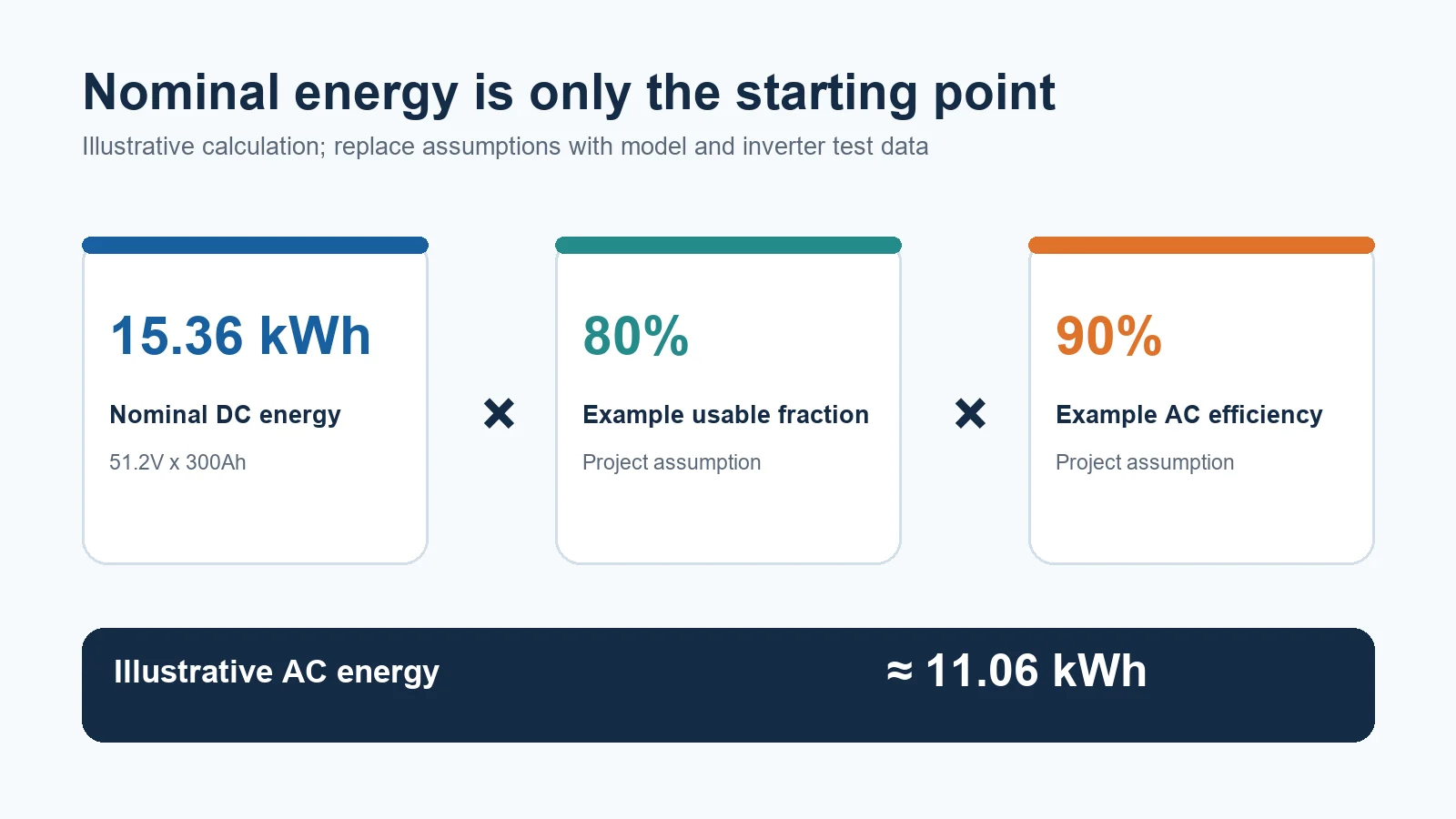
Example calculation: 15.36kWh × 80% × 90% = approximately 11.06kWh. The percentages are assumptions, not product specifications.
Build a load schedule rather than adding appliance nameplate powers and assuming they all run continuously. Record which loads must remain on, their typical operating power, duty cycle, and starting demand. A refrigerator cycling on and off has a different energy profile from a continuously operating heater. A short motor start can also challenge system power limits even when the daily energy requirement is modest.
Reserve energy needs its own line in the project brief. If part of the battery must remain available for outages, that portion is unavailable for routine solar self-consumption at the same time. Agree which service takes priority and how the inverter manages it. A useful proposal makes this operating decision visible instead of promising maximum savings and maximum backup from the same energy budget.
Increasing ampere-hours does not automatically increase permitted discharge current. A 300Ah battery with a limited BMS output may store enough energy for a load but still be unable to supply its instantaneous power. Compare continuous current, temporary peak current, peak duration, recovery conditions, and temperature derating against the inverter requirement.
For a simplified electrical example, 5,000W ÷ 51.2V equals approximately 97.7A before conversion losses. At an assumed 90% inverter efficiency, the corresponding DC current is about 108.5A at that same voltage. At a lower battery voltage, the current needed for the same output rises. This is why checking only the inverter wattage and nominal battery voltage can produce an inadequate current margin.
The current home storage product table lists a 0–100A charge/discharge range for SMJ 15KWh T01. That published row should not be converted into an unconditional 5kW AC output claim. Ask for the continuous rating, the applicable temperature range, the cutoff behavior, and the complete inverter pairing. The final system limit may be set by the battery, inverter, protective equipment, or approved installation design.
Keep energy and power acceptance tests separate. An energy test checks the delivered capacity under stated conditions. A power test checks whether the system sustains a specified load without reaching a limit or producing an unexpected interruption. A sample passing one test has not automatically passed the other. Both results should identify the hardware revision, firmware, temperature, and measurement boundary.
An inverter brand name alone is not enough to establish compatibility. Record the model number, firmware version, battery input voltage window, charging limits, and required communication method. Two units from the same brand can support different battery platforms, and firmware changes can alter how limits or state-of-charge information are handled.
Ask for a written pairing statement covering the proposed battery revision and inverter version. If the design uses CAN or RS485, identify the protocol, connector pin assignment, cable arrangement, termination requirements, and supported settings. A connector that physically fits does not establish communication compatibility. The documentation should also describe behavior if communication is lost or a battery limit is reached.
The commissioning plan should show how charge and discharge limits are exchanged and enforced. Check whether the inverter responds to temperature restrictions, low state of charge, and relevant fault messages. These are system behavior questions; they should be verified on the proposed pairing rather than inferred from a generic list of communication ports.
For a wider comparison of voltage classes and capacities, use the 51.2V HESS battery buying guide. Keep this 300Ah procurement decision focused on the exact configuration being quoted. A broad compatibility statement across a product family cannot replace approval of the particular system you intend to purchase.
A single high-capacity cabinet and several smaller modules may provide similar nominal energy, but they create different procurement and service requirements. Compare available installation space, handling access, replacement strategy, communication architecture, and the permitted expansion arrangement. The simpler option depends on the actual site and the supported product design.
Do not assume that independently available batteries may be connected together. Parallel operation requires manufacturer approval for the exact models and revisions, including maximum unit count, current sharing, communication, protection, and commissioning conditions. Mixing capacities, ages, or firmware versions may be restricted. Ask for those restrictions before promising future expansion to a customer.
Service planning also changes with architecture. Replacing one large cabinet may require a different handling method from replacing a smaller module. Conversely, a modular system can involve more connections and more coordination between units. Request the recommended maintenance approach and identify which operations are intended for qualified service personnel. Neither architecture should be described as automatically superior without a project comparison.
If the project needs an integrated inverter rather than a battery-only package, review the all-in-one energy storage category. For buyers comparing complete systems around the 15kWh range, the 15kWh HESS selection guide provides the broader system discussion. An all-in-one product name does not establish that its battery is exactly 300Ah.
Specify whether the equipment will be indoors, in a sheltered utility area, or exposed to outdoor weather. Include expected temperature, humidity, condensation risk, dust, salt exposure, altitude, and the proposed mounting location. A cabinet photograph cannot establish an ingress protection rating or suitability for every environment. Obtain model-specific environmental limits and installation instructions.
Dimensions alone also leave important questions unanswered. The installer needs service clearances, cable entry locations, allowable mounting orientation, equipment mass, and handling instructions. Check the delivery route and whether the equipment can pass through doors, stairs, or service openings. Packaging dimensions and shipping weight can differ from the installed product dimensions.
Electrical protection, earthing, isolation, cable selection, and local approvals must be addressed by qualified personnel using the approved manuals and applicable requirements. This guide is a purchasing aid, not an installation procedure. A low-voltage label does not remove high-current, short-circuit, or stored-energy hazards. Include responsibility for system design and commissioning in the supply agreement.
If the application is genuinely a factory microgrid or a larger commercial installation, reassess the system architecture rather than stretching a home battery label to cover the entire plant. The commercial HESS sizing guide explains how to begin with load and system requirements. The final product category should follow the engineering need.
The lowest unit price may represent a narrower supply scope. Ask every supplier to quote the same battery configuration, accessories, documentation, testing, packaging, delivery terms, and support responsibilities. Record optional items separately so the buyer can see which costs are included and which will be incurred later.
| Quotation item | Evidence to request | Decision it supports |
|---|---|---|
| Battery identity | Model, revision, nominal voltage, Ah and energy | Confirms the offered configuration matches the order |
| Operating limits | Current, voltage, temperature and usable-energy conditions | Checks suitability for the intended load profile |
| Inverter pairing | Exact model, firmware and written interface confirmation | Establishes what must be tested before rollout |
| Physical delivery | Drawing, mass, packaging and included accessories | Allows installation and logistics planning |
| Quality and documents | Relevant model documents and agreed sample test results | Makes product acceptance traceable |
| Commercial support | Warranty terms, exclusions, service process and change notification | Clarifies responsibility after delivery |
For any claimed certification or test report, check the model designation, issuing organization, scope, date, and relationship to the supplied assembly. A company-level certificate and a product test report answer different questions. Do not assume that a document for one battery capacity or enclosure automatically applies to a customized version.
Treat lifetime cost as a scenario calculation until the inputs are supported. Installation cost, energy throughput, replacement assumptions, service expense, tariff structure, and operating strategy all affect the result. A cycle-life number alone does not establish a payback period. Require the test conditions and warranty terms behind any longevity claim before using it in a customer proposal.
A sample order should test the configuration that will be supplied in production. Freeze the battery model, cell configuration, BMS revision, firmware, enclosure, labels, connectors, and documentation version. If a supplier proposes a substitution during evaluation, record it and decide whether affected tests must be repeated.
Agree acceptance criteria before the sample arrives. The plan can cover identification and documentation, physical inspection, capacity measurement under defined conditions, inverter communication, sustained operation, and agreed fault-response checks. Testing should be carried out by qualified personnel with suitable equipment and an approved procedure. Avoid improvised fault testing or treating an informal demonstration as an acceptance report.
Record measurements alongside conditions. A capacity figure without discharge rate, temperature, cutoff limits, and instrument information is difficult to compare with another result. Likewise, a successful inverter startup does not demonstrate correct behavior across charging, discharge, standby, and restart. Keep a short results sheet that distinguishes tested behavior from features that remain unverified.
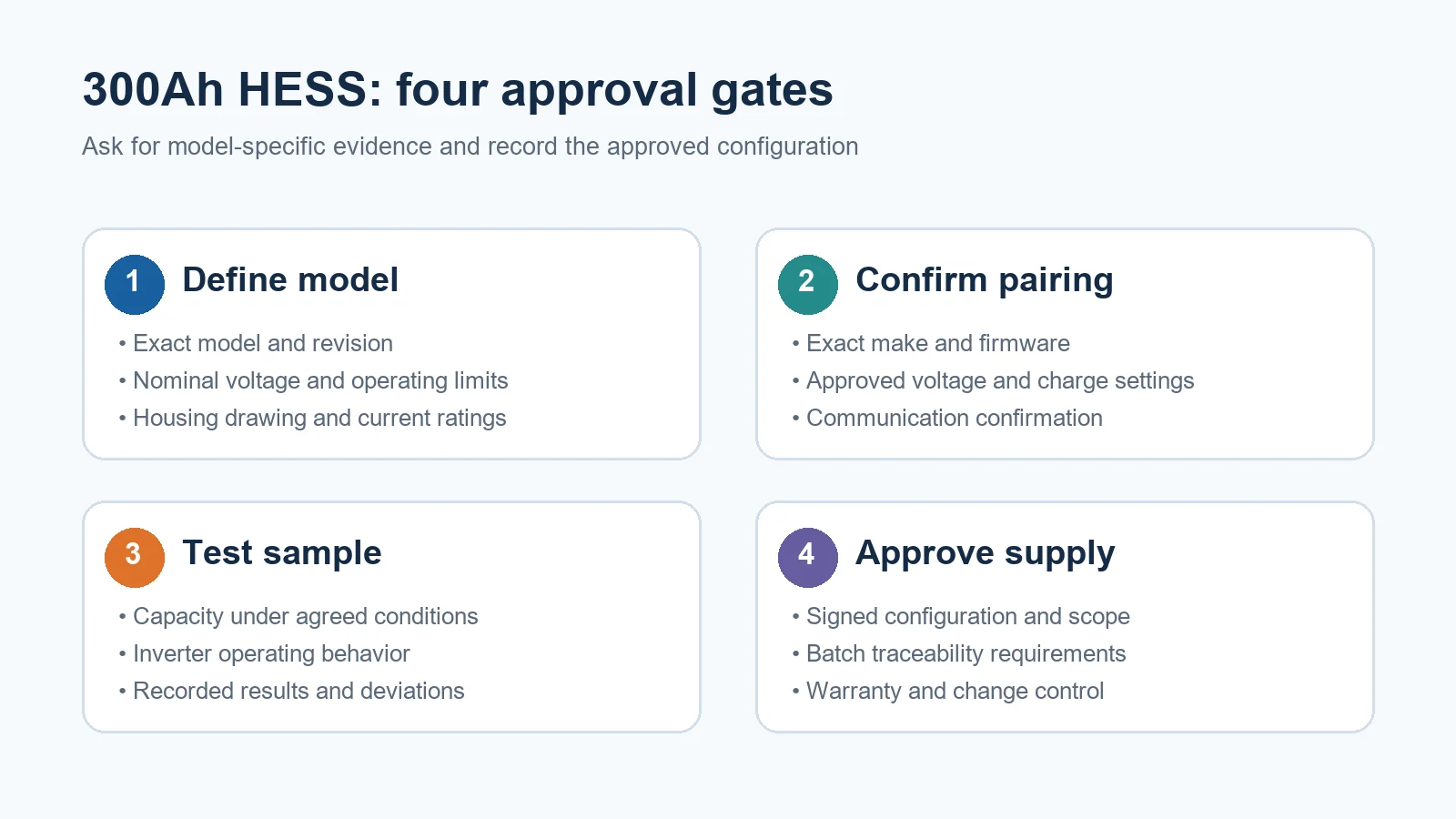
Procurement workflow illustration: define the model, confirm the pairing, test the sample, and approve repeat supply.
For repeat production, ask how serial numbers, critical components, firmware, and inspection records are traced. Set a notification process for changes that could affect performance or compatibility. The purpose is to make later deliveries consistent with the approved sample, not merely to collect more paperwork. Clear change control can prevent a small undocumented revision from creating installation problems across a fleet.
Prepare a brief that states destination market, application, expected order quantity, exact or acceptable capacity range, inverter details, backup target, and installation environment. Add enclosure constraints, branding requirements, interface preferences, documentation needs, and your sample approval schedule. Identify mandatory requirements separately from preferences that can be discussed.
For example, describe a request as a 48V-class residential solar battery project requiring confirmation of an exact 300Ah option, or approval of a documented alternative. Attach the inverter information and load schedule. Ask the supplier to return a configuration sheet, a list of deviations from the request, and a quotation showing included accessories. This creates a clear basis for technical review and commercial comparison.
Mottcell presents its battery and energy storage business on the company About page, while its customized energy storage category is a starting point for discussing project requirements. The feasibility, specification, documentation, minimum order quantity, and delivery terms for a customized 300Ah configuration need written confirmation for your project.
At a true nominal voltage of 48.0V, 300Ah calculates to 14.4kWh. At 51.2V, it calculates to 15.36kWh. Confirm the actual pack specification; neither figure is a guarantee of usable AC energy.
The home storage table reviewed for this guide lists SMJ 15KWh T01 with 280Ah/314Ah options. An exact 300Ah requirement needs a written configuration proposal. Do not assume the category label or a nearby capacity proves availability.
Provide the destination market, application, inverter model and firmware, required voltage and capacity, load profile, installation conditions, quantity, and documentation requirements. Ask for model-specific limits, included accessories, and a sample acceptance plan.
An effective sourcing decision connects capacity, current, inverter behavior, site conditions, and evidence. Confirm the exact offered configuration first, compare quotations on the same scope, and approve the sample before scaling supply. This approach gives procurement and engineering teams a shared basis for deciding whether a battery meets the project.
Send your requirements to Mottcell with your inverter details and load schedule. Request confirmation of the available configuration and the documents needed for your market before placing an order.
Prepared by Mottcell. Product-reference check: September 30, 2026. Published website information is a starting reference; the approved model specification and project agreement govern the supplied configuration. Example calculations are not laboratory results.
48V 300Ah HESS Supplier: Voltage, Runtime and OEM Guide
48V 100Ah HESS Supplier: 5.12kWh Solar OEM Buying Guide
12.8V 200Ah Battery Pack Factory: OEM Sourcing Guide
Commercial HESS Supplier: Factory Microgrid Sizing Guide
51.2V HESS Battery Supplier: 100Ah to 314Ah Capacity Guide
12V LiFePO4 Battery Pack Manufacturer: 50Ah-314Ah OEM Guide
16kWh HESS Supplier: 51.2V 314Ah Buyer’s Guide
5kWh HESS Supplier: Indoor Modular Battery Buying Guide
Established in 2005
In 2009, it was awarded the title of "National High tech Enterprise"
 zoe@mottcell.net
WhatsApp: 8617388790296
Fax: 86-0755-84042963
Skype: live:b0ebaecbb8782516
WeChat: +8613428749632

 VR show
 CN
CN Home >


