
 Jun 22, 2026


A 12.8V 200Ah battery pack factory should be able to answer a buyer's questions about the complete pack, not only quote a capacity printed on a case. For an OEM, solar integrator, equipment builder, or distributor, the practical decision is whether a particular battery can fit the enclosure, deliver the required current, work with the charger and controls, and arrive with evidence appropriate to its destination market. A 200Ah label alone establishes none of those things.
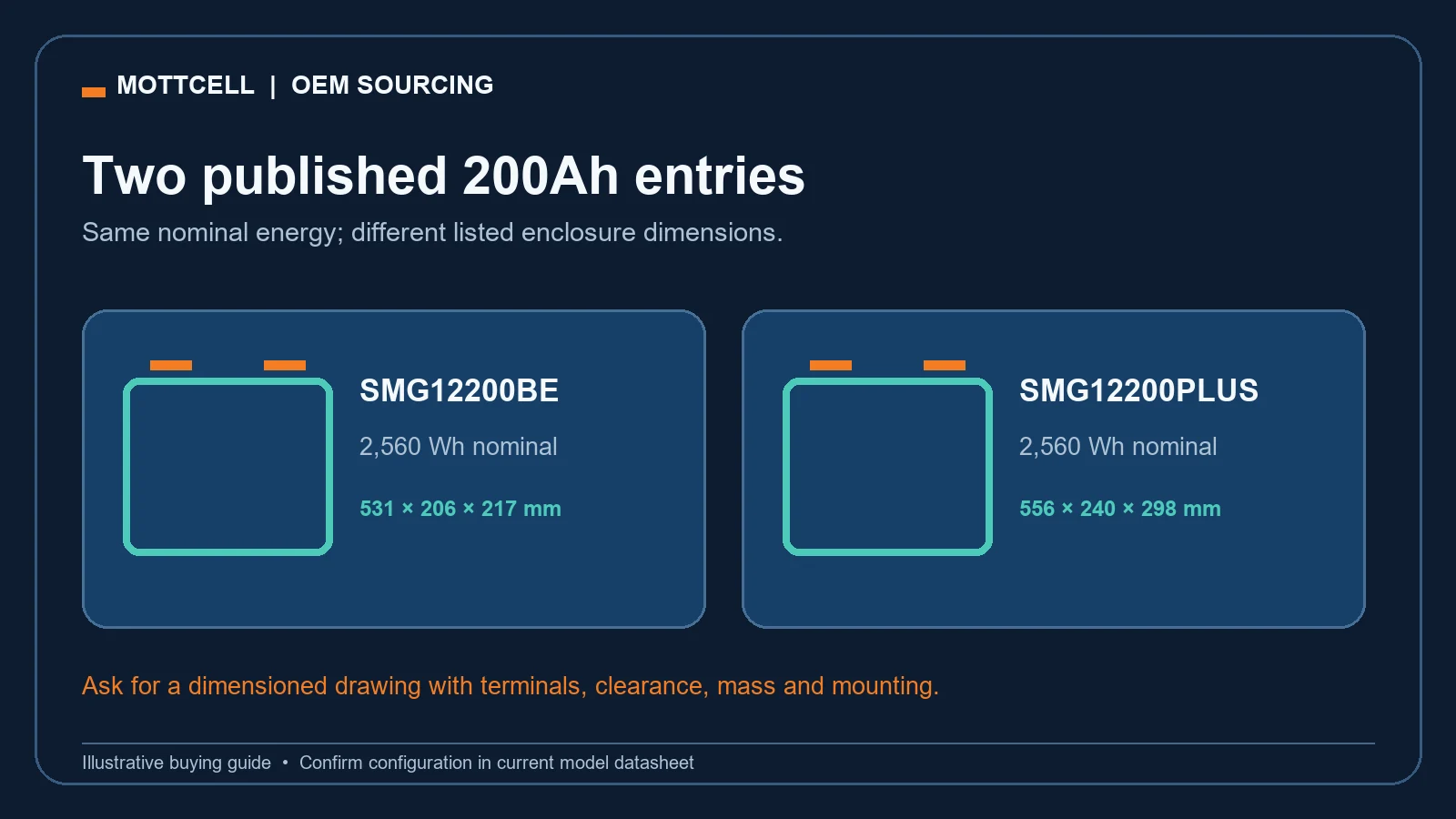
This guide uses the two 200Ah models currently listed on Mottcell's energy storage battery page as concrete starting points: SMG12200BE and SMG12200PLUS. Both are shown as 200Ah, 2,560Wh products, but their listed dimensions differ. The article explains what the published figures mean, how to test an application against them, what to ask a prospective supplier, and how to write a quotation request that can be evaluated against other offers. It does not treat a catalog entry as a completed engineering approval.
Mottcell publishes the values discussed below on its energy storage battery product page. A buyer should request a current, model-specific datasheet and drawing before using any figure in a purchase specification. Production revisions, BMS options, cable or terminal arrangements, and destination-market requirements can change the answer. Where a value is a calculation rather than a published test result, we label it as such.
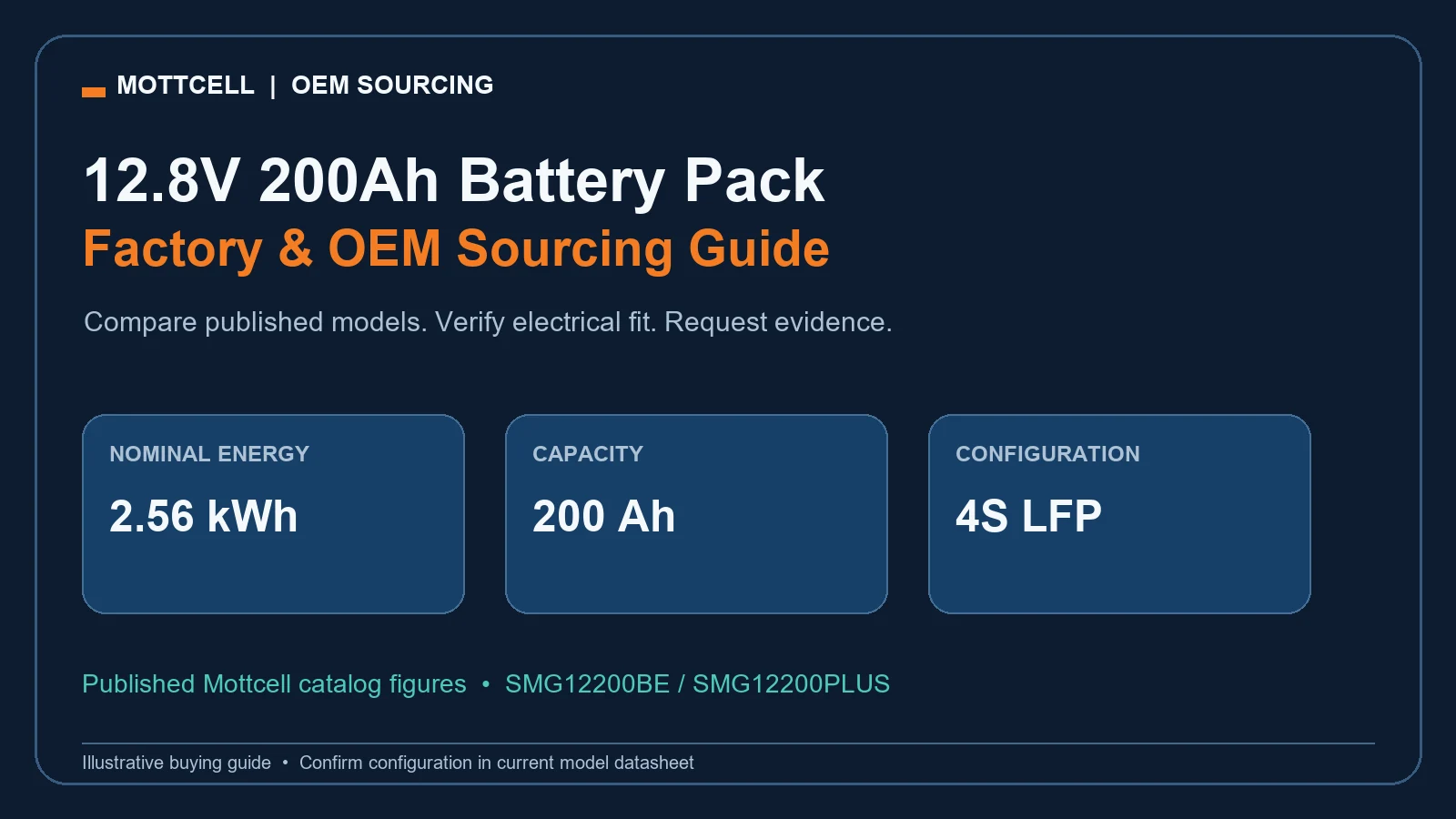
In ordinary purchasing language, a 12V lithium battery often means a four-cell-series lithium iron phosphate (LiFePO4 or LFP) architecture with a 12.8V nominal voltage. The chemistry and nominal cell voltage explain the 12.8V label; they do not by themselves prove that a battery is electrically interchangeable with every lead-acid system described as 12V. The permitted charge voltage, low-voltage cutoff, current limits, control interface, and installation conditions still need to be compared with the host equipment.
Ampere-hours describe charge capacity. Multiplying nominal voltage by capacity gives a nominal energy figure: 12.8V × 200Ah = 2,560Wh, or 2.56kWh. This arithmetic matches the 2,560Wh shown for Mottcell's SMG12200BE and SMG12200PLUS in the published table. It is a useful common basis for comparing catalog entries, but it is not a guarantee that an application can withdraw 2.56kWh at its terminals under every temperature, load, age, or cutoff setting.
Usable energy depends on the allowed state-of-charge window, discharge rate, temperature, BMS thresholds, and conversion losses downstream. If an integrator wants to estimate runtime, start with the project's measured or specified load profile, then ask for discharge data at the relevant current and temperature. A rough calculation can expose a mismatch early, but validation requires the manufacturer's test conditions and the system designer's electrical review.
For example, a constant 400W load would consume 1.2kWh in three hours before inverter and wiring losses. That is an illustrative demand calculation, not a claimed runtime for either Mottcell model. If the battery feeds an inverter, the inverter's efficiency, standby consumption, startup surge, and low-voltage settings must also enter the estimate. A buyer who provides only “three hours of backup” without a load curve leaves the supplier guessing about the actual battery specification.
The catalog currently lists SMG12200BE and SMG12200PLUS at 200Ah and 2,560Wh. For both rows, it shows a 4S configuration and lists hardware/software BMS options, a charging/discharging current field of 0–200A, a recommended charging current of 0.5C, and a maximum continuous current of 200A. It also lists 600A for three to five seconds as an instantaneous current. These are catalog statements, not a substitute for a current datasheet, a current-versus-time curve, or a project-specific sign-off.
| Published item | SMG12200BE | SMG12200PLUS | Buyer check |
|---|---|---|---|
| Nominal capacity | 200Ah | 200Ah | Confirm test rate, temperature and acceptance tolerance. |
| Nominal energy | 2,560Wh | 2,560Wh | Ask how usable energy is defined for the proposed BMS settings. |
| Published dimensions | 531 × 206 × 217mm | 556 × 240 × 298mm | Request a dimensioned drawing including terminals and clearances. |
| Enclosure material | ABS | ABS | Confirm environmental rating and mounting conditions for the exact variant. |
| Listed maximum continuous current | 200A | 200A | Confirm protection settings, cable size and thermal test conditions. |
| Listed instantaneous current | 600A for 3–5s | 600A for 3–5s | Validate the load's actual surge waveform and permitted repetitions. |
The unusually different enclosure sizes are a good reason to request drawings rather than buying from a nameplate. Dimensions in a web table may omit handles, terminal studs, cable bend radius, access for service, and ventilation clearance. The buyer should also confirm mass, terminal orientation, ingress protection, mounting method, and shipping package dimensions. None of these should be inferred from a product photograph.
The table's 0–200A field is broad. It does not mean every charge current from zero to 200A is recommended for every ambient condition, nor that the same limit applies to every BMS option. At 200Ah, a recommended charge rate of 0.5C corresponds arithmetically to 100A. That calculation helps a buyer frame questions, while the selected cell, charger, temperature range, and BMS settings govern the actual allowed profile. Ask for explicit continuous and peak charge and discharge curves for the ordered configuration.
For a small solar installation, identify the loads, daily energy demand, required autonomy, solar charge-controller settings, and expected ambient temperature. For a mobile machine, the critical questions may instead be acceleration current, regenerative behavior, vibration, wiring space, and charging opportunity. A backup system may have modest average power but a high starting surge. The words “solar,” “industrial,” and “backup” are too broad to stand in for an electrical specification.
Prepare a simple duty-cycle table: each load's power or current, typical operating duration, simultaneous operating conditions, peak duration, and required reserve. Note whether the pack supplies DC equipment directly or connects to an inverter. The voltage at which the equipment shuts down matters as much as the nominal battery voltage. When loads are intermittent, a time series or representative daily profile is more useful than a single average wattage.
Next, document the host system's electrical boundaries. Include charger model, charge-voltage range, current limit, temperature compensation behavior, inverter model if present, required communications, and the existing fuse or breaker arrangement. A lead-acid charger may use a profile that is inappropriate for an LFP pack; its presence in a “12V” installation does not establish compatibility. An OEM should get written confirmation for the actual charger–battery combination before field deployment.
Physical integration is often the hidden reason an attractive battery quotation fails. The supplier needs the available footprint, mounting direction, terminal location, service access, ingress exposure, shock or vibration conditions, and the wiring path. If the equipment is exported, identify the destination market and intended use so the required documentation can be defined. A catalog battery, a custom pack, and a complete energy storage system can have different scopes and approval obligations.
For projects that have not settled on 200Ah, compare the entire 12V LiFePO4 capacity selection guide before specifying one size. A nearby 100Ah or 280Ah option may fit the load, weight, volume, or parallel-system plan better. The comparison should use the same assumptions for usable energy and discharge limits, rather than comparing ampere-hour labels across unlike voltages or test conditions.
The battery management system protects the cells within defined limits and may provide information to the host equipment. Buyers should ask which protection functions are included in the exact hardware or software BMS variant, what thresholds are configurable, and how a trip is reported and recovered. “Smart BMS” is not a sufficiently precise requirement for a purchase order. Two packs with the same nominal energy can behave differently when a motor starts, a charger reconnects, or the enclosure becomes hot.
Ask for the continuous current, peak current, duration, recovery conditions, and the test ambient for each quoted BMS. A headline 600A instantaneous figure is useful only if its three-to-five-second condition matches the application's surge and the repeated-event duty cycle. A motor's inrush may last milliseconds, seconds, or longer depending on its controller and load. The peak-current label should be checked against the entire event, including wiring and connector ratings, not used as a universal pass certificate.
Communications must be described at protocol level. If the system needs CAN or RS485, request the actual supported interface, pinout, message map, baud rate, connector, and host compatibility evidence for the proposed model. The current public 200Ah table describes BMS options but does not, by itself, confirm a specific CAN or RS485 implementation on both models. The supplier should distinguish standard functions from optional custom integration, and quote any firmware or qualification work separately.
Temperature behavior deserves the same scrutiny. An LFP chemistry label does not say whether the pack includes low-temperature charge inhibition, heaters, or a sensor at the intended location. Request the allowable charging and discharging temperature ranges, the cell-temperature measurement method, and the pack's behavior when the limits are reached. For outdoor cabinets, marine equipment, or cold warehouses, also define moisture and condensation exposure. An enclosure material entry of ABS does not establish an IP rating.
Some buyers approach a 12.8V 200Ah battery as a lead-acid replacement. That can be possible in a specific design, but “drop-in” should be treated as a question to prove. Compare the equipment's acceptable voltage range with the battery's charge voltage, resting voltage, discharge cutoff, and transient behavior. Check the charger profile and whether equalization, desulfation, or temperature-compensated lead-acid modes can be disabled. Finally, review the wiring, fuse, and mounting arrangement against the new pack's dimensions and current capability.
The host may also interpret battery state using voltage. A voltage-based lead-acid fuel gauge can give misleading information for an LFP pack with a different voltage-versus-state-of-charge curve. If accurate state of charge is needed, ask how the proposed BMS measures and communicates it, how it is initialized, and what the host display can receive. A pack may physically fit but still require a controls change to produce a safe, usable operator experience.
Series or parallel installations require a separate approval. Do not infer that two 12.8V packs can simply be connected in series for a 24V bus, or that unlimited parallel strings are allowed. Matching requirements, balancing, current sharing, protection coordination, cable lengths, and service procedures need manufacturer-specific instructions. The quotation should name the approved topology, maximum number of packs, and any required external distribution equipment.
When the project is truly a higher-voltage home energy storage system rather than a 12V equipment battery, begin with the correct product family instead of forcing a 12V module into the architecture. Mottcell's energy storage system range provides a separate starting point for integrated storage proposals. This distinction matters for inverter coupling, installation responsibilities, and the documents an integrator must obtain.
A factory evaluation should separate what is visible on a website from what can be documented for a purchase. Ask who owns the pack design, who produces the BMS, where assembly and final testing occur, and which processes are controlled for the quoted model. Request a sample build record or agreed inspection plan if traceability matters. A tour video or a general corporate certificate can introduce a supplier, but it does not prove that one configured pack passed a particular test.
Cell consistency is important in a series pack, yet a buyer should ask for measurable acceptance criteria rather than a phrase such as “Grade A matched cells.” Useful evidence may include the cell model and supplier, capacity and internal-resistance acceptance bands, incoming inspection records, and the criteria used before assembly. The level of detail available may depend on a confidentiality agreement. If the supplier cannot provide every raw data record, agree on an auditable summary and sample inspection method.
For pack assembly, ask how joints are made and inspected, how insulation and spacing are checked, and what tests are conducted after enclosure assembly. Do not assume a particular weld process merely because a general article describes it. Request the actual process flow and test report applicable to the selected SKU. A final test plan may include voltage, polarity, insulation, functional BMS checks, and charge/discharge sampling, but the exact scope should be written into the procurement agreement.
The buyer should distinguish compliance claims from documentation. Ask which transport documents, cell reports, pack-level reports, and market-specific approvals are available for the exact model and destination. A logo on a catalog page is not the same as a current test report with the matching model and revision. If the supplier proposes an OEM modification, confirm whether the change affects earlier test coverage and who pays for any new evaluation.
Mottcell describes its broader 12V battery pack manufacturing approach elsewhere on the site. Use that overview to form questions about capabilities; use the current model drawing, bill of materials scope, and agreed test documents to approve a specific purchase. Marketing material and engineering evidence serve different purposes.
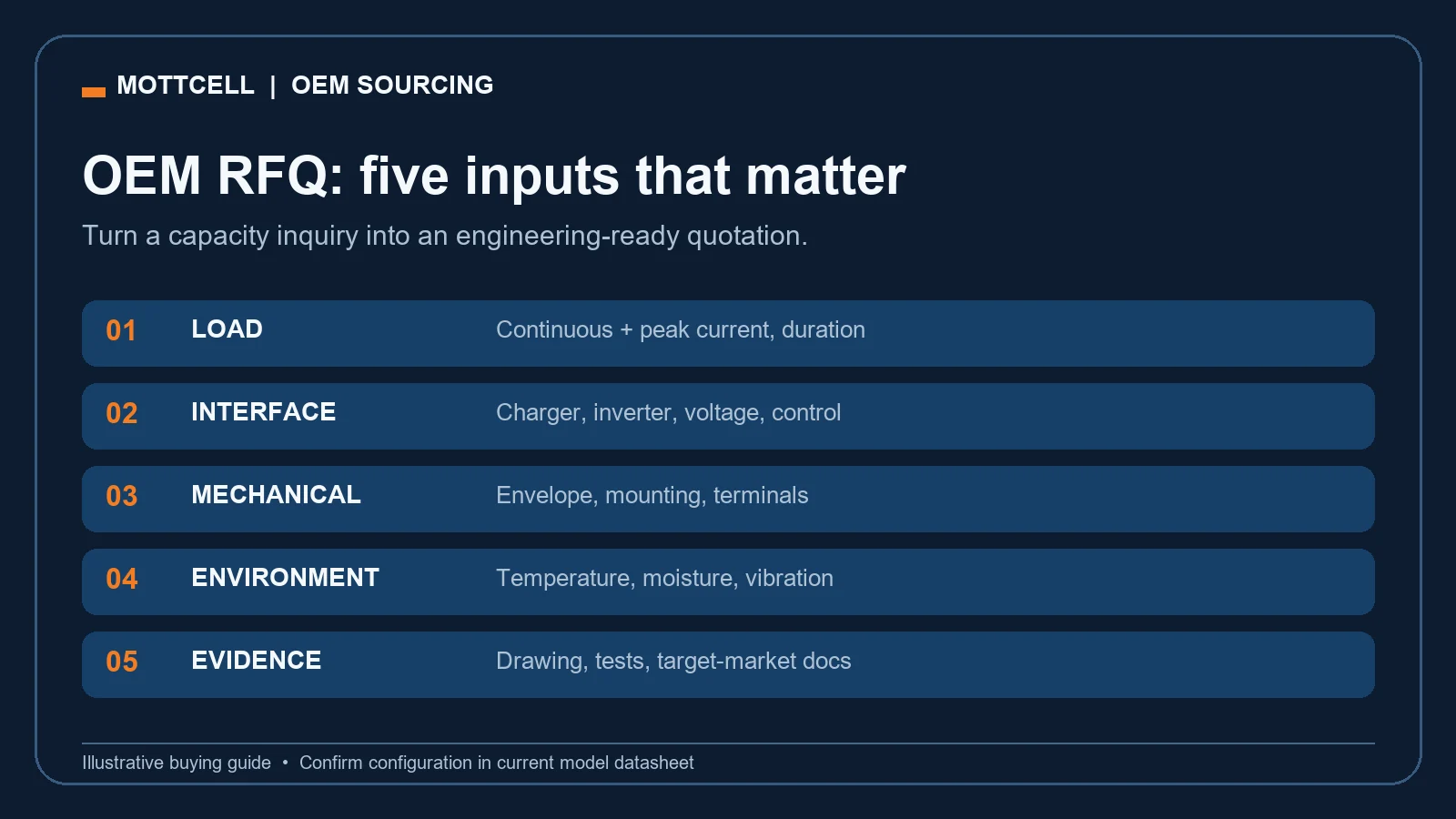
Suppliers can quote different things under the same capacity headline. One offer may include a standard ABS case and basic BMS; another may include a custom enclosure, communication interface, extra testing, and different packing. Price comparisons are meaningful only after the buyer aligns the deliverables. Ask each bidder to state the exact model and revision, the included BMS option, terminals and cables, enclosure and mounting features, documentation, test scope, warranty terms, and what remains excluded.
| RFQ field | Information to supply | Why it matters |
|---|---|---|
| Application and load | Equipment type, average and peak current, duration and duty cycle | Screens the cell, BMS and thermal design against real demand. |
| Electrical interface | Charger and inverter models, voltage windows, fuse scheme, communications | Prevents a nominal-voltage match from hiding an integration mismatch. |
| Mechanical interface | Envelope, orientation, drawing, terminals, clearances, exposure | Determines whether a published enclosure can actually be installed. |
| Commercial scope | Forecast volume, pilot quantity, destination, target delivery terms | Separates sample validation from production planning. |
| Evidence required | Datasheet revision, test records, transport and market documents | Makes claims reviewable before purchase approval. |
For sample orders, define a measurable acceptance process. Record the pack's appearance, label, dimensions, open-circuit voltage, BMS communication behavior if ordered, and basic functional response to the agreed test setup. Use a controlled test procedure and qualified personnel for electrical work. If the sample is approved, tie production to the sample's drawing and revision; otherwise a later lot may differ without anyone noticing.
For ongoing OEM programs, add change control. Ask how the supplier notifies buyers about cell substitutions, BMS firmware changes, enclosure revisions, and end-of-life components. Define which changes require requalification. The cost of a pack includes support for field issues, spare parts, and predictable documentation, not only the initial unit price. This is a sourcing framework rather than a claim that any specific supplier produces a particular return on investment.
The published 200Ah rows give buyers an initial comparison: both list 2,560Wh, while SMG12200BE is 531 × 206 × 217mm and SMG12200PLUS is 556 × 240 × 298mm. They also flag current figures that deserve a detailed conversation. They do not publish every condition required to approve solar charging, AGV duty, marine exposure, installation in a sealed box, or a regulated export market. Treat missing information as a request for evidence, not as an implied feature.
The stated dimensions should be reconciled with a drawing and a physical sample. The 200A continuous and 600A short-duration catalog values should be reconciled with current-versus-time, temperature, and protection information. The “hardware/software” BMS wording needs a configuration-specific explanation. Ask for charge parameters, temperature limits, available communication, pack mass, protection ratings, and serial/parallel guidance before approving the design. A competent supplier should be able to identify which questions require a custom variant rather than forcing an off-the-shelf answer.
Buyers also need to keep nominal and usable energy separate in commercial discussions. Calling this a 2.56kWh nominal pack is justified by the published figures and simple arithmetic. Advertising a fixed backup duration without a load and test condition would not be. Likewise, “200Ah” is capacity, whereas “200A” is current; they are different dimensions despite similar numbers. This distinction prevents a procurement specification from accidentally substituting charge capacity for power capability.
If your project needs more energy in a 12V family, review the separate 12V 280Ah pack article and request its current model data. A larger capacity may increase nominal energy but also change case dimensions, mass, charging time, and the permitted current. Select it against the application rather than assuming that a higher ampere-hour number is automatically the better purchase.
Begin with the application profile, then shortlist a published model. Compare nominal energy and envelope as a first filter. Send the supplier the load curve, charger and inverter details, environmental exposure, electrical interface, and required documentation. Ask for a model-specific datasheet and drawing, including BMS and current limits. Use those materials to decide whether to test the standard SKU or request a customized variant. Only then fix the sample test plan, price scope, and production acceptance criteria.
The sequence protects both sides. The buyer avoids specifying a pack that cannot fit or communicate with the host. The supplier can quote the right engineering work instead of hiding uncertainty behind a generic capacity label. If a pilot fails, a documented interface and acceptance plan makes the root cause easier to locate. None of this eliminates engineering risk, but it turns a vague “12V 200Ah battery” request into a reviewable purchase decision.
No automatic equivalence should be assumed. “12V” is a broad system label, while 12.8V is a nominal LFP pack voltage. Compare charging profile, acceptable voltage window, current, protection behavior, dimensions, and monitoring before approving a replacement. Request written compatibility for the exact host and battery configuration.
The nominal calculation is 12.8V × 200Ah = 2,560Wh, or 2.56kWh, and that matches the two current Mottcell catalog entries discussed here. Usable energy and runtime depend on the load, allowed discharge window, temperature, conversion losses, and the selected BMS settings. Ask for test conditions before using a runtime claim in a customer proposal.
Send the equipment and load profile, continuous and peak current, charger/inverter models, voltage limits, space and terminal drawing, environment, destination market, sample quantity, forecast volume, and required evidence. Ask the supplier to identify the exact model, revision, BMS option, included documentation, and any assumptions or exclusions in the quotation.
If SMG12200BE or SMG12200PLUS looks relevant, use their published specifications as a starting shortlist and send Mottcell your application requirements. Ask for the current datasheet, dimensioned drawing, BMS option sheet, test scope, and documents for your target market. If neither standard enclosure fits, describe the constraint rather than assuming a custom configuration is already qualified. The goal is a battery and evidence package that your engineering and procurement teams can assess together.
For a model-specific discussion, contact Mottcell with your load profile and RFQ. Include the desired quantity and country of use so the response can distinguish a standard sample from a customized OEM proposal.
48V 300Ah HESS Supplier: Voltage, Runtime and OEM Guide
48V 100Ah HESS Supplier: 5.12kWh Solar OEM Buying Guide
12.8V 200Ah Battery Pack Factory: OEM Sourcing Guide
Commercial HESS Supplier: Factory Microgrid Sizing Guide
51.2V HESS Battery Supplier: 100Ah to 314Ah Capacity Guide
12V LiFePO4 Battery Pack Manufacturer: 50Ah-314Ah OEM Guide
16kWh HESS Supplier: 51.2V 314Ah Buyer’s Guide
5kWh HESS Supplier: Indoor Modular Battery Buying Guide
Established in 2005
In 2009, it was awarded the title of "National High tech Enterprise"
 zoe@mottcell.net
WhatsApp: 8617388790296
Fax: 86-0755-84042963
Skype: live:b0ebaecbb8782516
WeChat: +8613428749632

 VR show
 CN
CN Home >


