
 Mar 18, 2026


Choosing a 12V LiFePO4 battery pack manufacturer starts with a clear specification: required runtime, continuous and surge current, charging equipment, installation space and the evidence needed before volume production. A capacity label alone cannot tell an OEM buyer whether a battery will fit the product or operate reliably in its intended environment.
This guide compares 12.8V capacity classes from 50Ah to 314Ah and explains how to evaluate the pack, battery management system, sample testing and quotation scope. Use the Mottcell energy storage battery range as a starting point for a model discussion. Availability, dimensions, current limits and customization options must be confirmed for the exact configuration being quoted.
Quick answer: specify energy and power separately, check every charging source, request a model-specific drawing and BMS specification, and agree on sample acceptance criteria before ordering. The calculations below are planning examples, not measured performance claims for a Mottcell product.
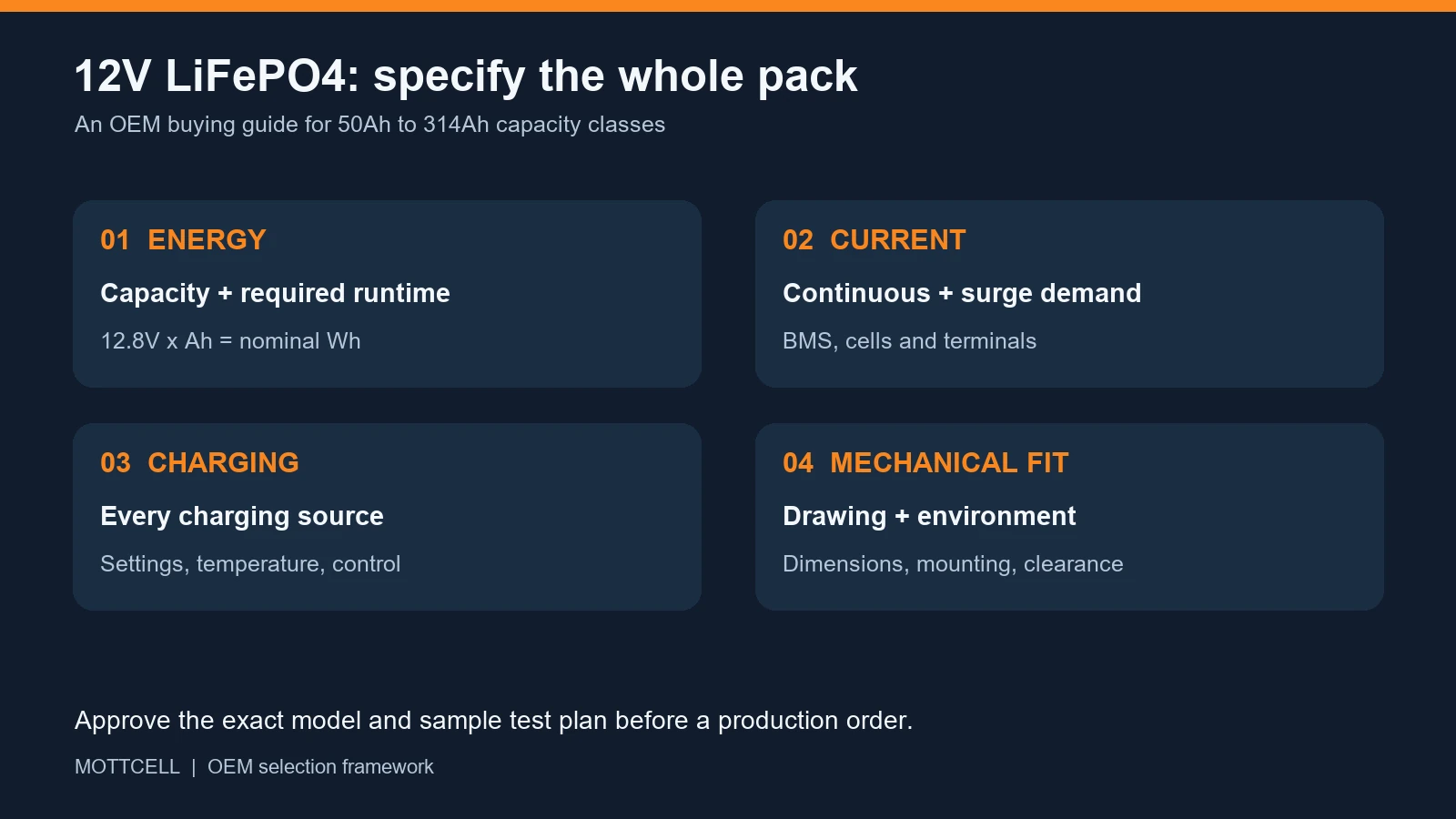
OEM selection framework. This diagram explains purchasing decisions and does not depict a particular battery model or customer installation.
Many buyers use 12V as a system category. A conventional four-cell series LiFePO4 pack has a nominal voltage of 12.8V, calculated as four times 3.2V. The term 4S describes that series arrangement. It does not describe the enclosure, the permitted charging settings or the maximum discharge current.
Nominal voltage is a reference value used for classification and energy calculations. Actual terminal voltage changes with state of charge, load, temperature and the battery design. A 12.8V label therefore does not promise a regulated 12.8V output throughout discharge. Equipment that needs tightly controlled voltage may require an appropriate converter as part of the system design.
For an OEM project, compare the battery operating window with the load input window and the charger output settings. Ask what happens when the BMS disconnects, how the system restarts, and whether the connected electronics tolerate those transitions. These checks are particularly useful when replacing a lead-acid battery in an existing product whose electronics were designed around a different charging profile.
Ampere-hours describe charge capacity. Watt-hours make it easier to compare stored energy when voltage is also known. For the same nominal 12.8V platform, nominal energy equals voltage multiplied by ampere-hours. Divide watt-hours by 1,000 to express the result in kilowatt-hours.
| Capacity class | Calculated nominal energy at 12.8V | Question for the supplier |
|---|---|---|
| 50Ah | 640Wh / 0.64kWh | Does it meet the required runtime within the space limit? |
| 100Ah | 1,280Wh / 1.28kWh | Are the terminals, current rating and charging method suitable? |
| 200Ah | 2,560Wh / 2.56kWh | Can the pack support the full load profile? |
| 280Ah | 3,584Wh / 3.584kWh | What are the approved enclosure and installation conditions? |
| 300Ah | 3,840Wh / 3.84kWh | What usable energy is available at the specified load? |
| 314Ah | 4,019.2Wh / 4.0192kWh | Which exact model, BMS and test conditions support the quotation? |
The table is an arithmetic comparison, not a stock list or a promise that every capacity shares the same housing. A 314Ah configuration contains about 12.1% more nominal energy than a 280Ah configuration at the same voltage. That difference does not establish an improvement in energy density, because density also depends on pack mass or volume.
Use capacity as an initial filter, then compare the physical and electrical specifications. A smaller battery with a suitable current rating can be more appropriate for a short, demanding load than a larger pack whose BMS cannot support that load. Conversely, a modest continuous load may need substantial capacity if the backup period is long.
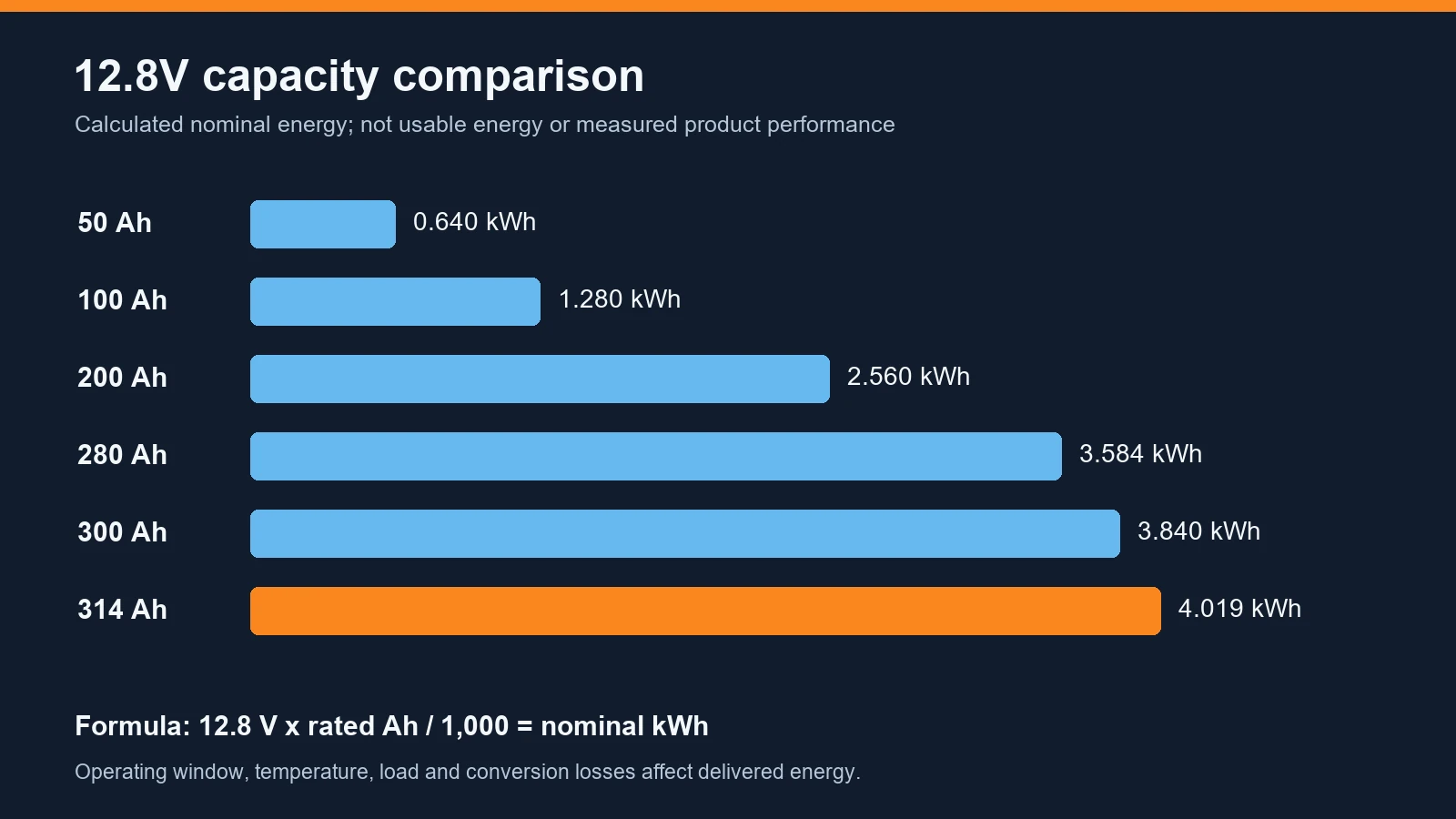
Calculated nominal energy equals 12.8V multiplied by rated ampere-hours. Usable energy and delivered AC energy will differ.
Start with a measured load schedule. Record the power of each device, operating hours and whether devices run simultaneously. A refrigerator, pump or actuator may have a short starting demand that is much higher than its average consumption. Separating energy requirements from peak demand helps prevent a battery that lasts long enough on paper but trips during startup.
For an illustrative 100Ah, 12.8V pack, nominal energy is 1,280Wh. If the planning assumption is an 80% usable energy window and a 90% inverter efficiency, the estimated energy available to an AC load is 1,280 × 0.80 × 0.90 = 921.6Wh. A constant 100W AC load would then have an approximate runtime of 9.2 hours.
Those percentages are example inputs, not product ratings. Replace them with the approved operating window and the inverter efficiency at the expected load. Include standby consumption, cables, converters, temperature effects and an appropriate allowance for aging. For direct DC loads, use the efficiency of the actual DC path rather than automatically applying an inverter loss.
Work backward when runtime is the requirement. If a load needs 1,200Wh of delivered energy, the same illustrative assumptions imply 1,200 ÷ 0.80 ÷ 0.90 = about 1,667Wh of nominal energy, or about 130Ah at 12.8V. The next selection step is checking a suitable model and current rating, not treating 130Ah as a complete battery specification.
The BMS current rating must be evaluated alongside cell limits, terminals, internal connections, wiring and the thermal environment. A large Ah number does not automatically support a high-powered inverter. Ask for continuous discharge current, peak current, peak duration, recovery behavior and the conditions under which those figures apply.
As a simplified calculation, a 1,000W AC load through a 90% efficient inverter draws about 86.8A at 12.8V. At an illustrative loaded voltage of 11.5V, the same calculation gives about 96.6A. This lower voltage is an example input, not a recommended cutoff. Use the approved operating range when calculating the worst-case current for a real design.
A pack advertised with a 100A BMS therefore needs a closer review before being assigned to that application. There may be little allowance for startup demand, other loads or operating conditions. The BMS disconnect is a protective function, not a substitute for engineering the normal operating current and external protection correctly.
Provide the supplier with a current-versus-time profile where possible. Specify whether the high demand lasts milliseconds, seconds or minutes. Ask the supplier to identify the limiting component and to document any derating. For larger sustained loads, compare whether a higher system voltage is more appropriate before committing to a 12V architecture.
An existing installation may include an AC charger, solar controller, alternator charging circuit and an inverter/charger. Each source must be reviewed. A compatible-looking connector or nominal voltage label does not establish compatibility with the exact LiFePO4 battery configuration.
Request the approved charge voltage, charge current, temperature limits, termination behavior and any required communication. Ask whether lead-acid equalization, reconditioning or temperature compensation functions must be disabled. For vehicle applications, have the charging design reviewed for alternator behavior and the possible need for a suitable DC-to-DC charger.
Low-temperature charging deserves a separate question. Confirm the actual cell temperature limits, sensing arrangement and charge inhibition behavior. If a heater is proposed, ask how it is powered and controlled, and whether heating energy changes the runtime budget. Do not infer that heating or cold-charge protection is included because another model in the range has it.
Manufacturer manuals illustrate why these details matter. The Victron Lithium Smart installation guidance discusses battery configuration and temperature-related charging settings for its own products. Its values should not be copied into a Mottcell installation. Obtain the manual and written settings for the exact battery and charger combination.
Ask for a dimensioned drawing that shows the enclosure, terminal locations, polarity, mounting points and required clearance. Include space for cable bends, protective covers, service access and removal. An enclosure that fits into a tray can still be unsuitable if cables must be strained or terminals become inaccessible.
Confirm the mounting orientation, mass, restraint method and environment. An indoor equipment compartment, an exposed outdoor enclosure and a mobile installation present different requirements. If an ingress-protection rating is important, request the model-specific evidence and installation conditions. A rating shown on a different product cannot be assumed to apply to the pack being purchased.
Distinguish auxiliary energy storage from engine starting, traction and other specialized duties. For example, an RV house battery and a cranking battery face different load patterns. Use the power battery product category to discuss powered-equipment requirements, and make the intended duty explicit rather than selecting a battery solely from its voltage label.
Useful supplier evidence connects a delivered pack to an agreed specification. Ask for the cell identification, battery model, bill-of-materials revision, BMS version and production traceability method. A broad phrase such as premium cells does not replace measurable acceptance criteria or a clear process for managing changes between sample and production orders.
Cell matching is another area where a number requires context. If a supplier quotes voltage or resistance tolerances, ask about the measurement method, temperature, state of charge and acceptance rule. Values obtained under different conditions may not be comparable. Avoid evaluating a production process from an isolated tolerance or an attractive assembly-line photograph.
For electrical connections, request the relevant inspection and test records rather than relying on claims such as zero resistance or vibration proof. Any real current path has resistance. A practical review asks whether the design stays within its electrical and thermal limits under the agreed load and whether the verification method is appropriate for the application.
Mottcell provides company background through its About us page. The existing battery pack manufacturing and testing video can also support an initial supplier discussion. Company information and a video do not by themselves establish a particular model's test results, approved configuration or batch quality.
A sample order is most useful when the acceptance plan is written before shipment. State the test temperature, charge preparation, discharge current, end-of-discharge condition, measurement equipment and pass criteria. Keep capacity testing separate from surge testing, communication checks and fit verification so a successful result in one area does not hide a problem in another.
| Acceptance area | Evidence to request or record |
|---|---|
| Identity and mechanical fit | Model label, serial number, drawing revision, dimensions and terminal arrangement |
| Energy and continuous load | Measured result with temperature, current, voltage limits and test duration |
| Protection and recovery | Agreed manufacturer test method and documented behavior |
| Charging and communications | Charger model, settings, firmware and communication protocol where applicable |
| Production consistency | Approved sample reference, inspection plan and change-notification process |
Protection validation should use a qualified test arrangement and the manufacturer's procedure. Deliberately shorting a pack or defeating its protective functions is not an appropriate incoming-inspection shortcut. Ask the supplier to provide the relevant controlled test evidence and agree which checks your receiving team can safely perform.
When a sample passes, preserve its configuration as the reference. Record any differences between the sample and the proposed production build. A substitution in cells, protection hardware or firmware may change performance even if the outside label remains the same. The purchase agreement should explain which changes require notification and renewed approval.
Do not assume that four independently protected 12.8V packs can be connected in series, or that any number can be paralleled. The supplier must explicitly approve the configuration. Ask for the maximum permitted arrangement, preparation requirements, protection layout and restrictions on mixing ages, capacities or model revisions.
Parallel systems also require attention to current sharing and isolation. A bank's available output may change when one pack disconnects. The remaining batteries, cables and protective devices must be assessed for that condition. System designers should establish a documented connection plan rather than simply multiplying a single-pack current label by the number of packs.
If monitoring is required, specify what data is needed and who will use it. Bluetooth status, a local display and a CAN or RS485 port are different functions. A physical communication port does not prove that an inverter, controller or application understands the protocol. Request the protocol details and verify the intended combination during sample evaluation.
Projects that need a complete household storage platform should also review the energy storage system range. Selecting a purpose-designed system may provide a clearer supply boundary than assembling a bank of low-voltage packs, but the final decision still depends on the loads, inverter and installation requirements.
Ask each supplier to quote the same configuration and delivery scope. A battery-only price should not be compared directly with a package that includes communications, heating, a charger, a different enclosure or testing documentation. State which items are included, optional or supplied by the integrator.
For 280Ah, 300Ah and 314Ah offers, compare usable energy under equivalent conditions as well as nominal energy. Include installation effort, accessories, freight assumptions, service arrangements and replacement handling in the commercial review. Lower unit price does not resolve missing evidence, while a higher price does not itself prove better performance.
Request the written warranty, relevant exclusions and the evidence needed to make a claim. Keep cycle-life claims tied to their test conditions, retained-capacity endpoint and operating profile. A laboratory cycle figure cannot be converted directly into a guaranteed number of calendar years for every application. Likewise, certification and shipping documents should identify the relevant model and configuration.
Agree on quantities for samples, initial production and repeat orders. Ask which lead-time assumptions depend on configuration approval or component availability. Record the validity period of the quotation and how engineering changes affect price. This gives purchasing and engineering teams a common basis for deciding whether an offer is ready to progress.
A good request for quotation describes the job the battery must do. Include the destination market, application, DC or AC load, continuous power, surge profile and required backup hours. Attach a load schedule where available, and identify which requirements are firm and which can change during design review.
Then add the charging sources and exact equipment models, available space, mounting orientation, ambient conditions and expected duty cycle. State whether you need a standard enclosure or a custom arrangement. Include monitoring requirements, connection plans, documentation needs and the proposed sample acceptance procedure.
Finally, provide the sample quantity, expected order volumes and target schedule. Use the Mottcell contact form to request a model recommendation and a configuration-specific quotation. Ask the response to separate confirmed specifications, available options and items still requiring engineering validation.
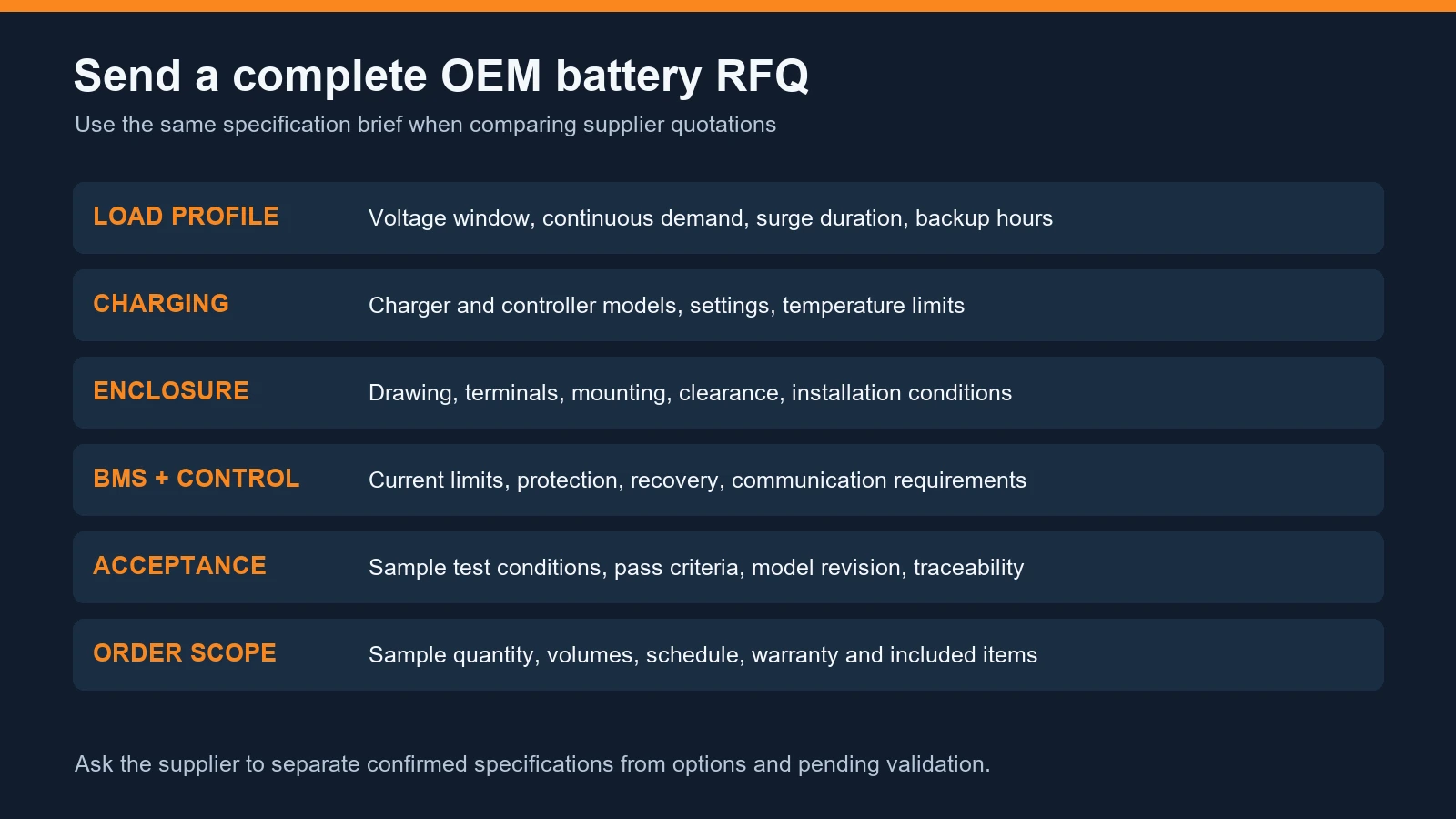
Use one specification brief across suppliers so their quotations and sample results can be compared consistently.
They can describe the same general system class, but interchangeability depends on the exact voltage window, charging settings, current limits and mechanical fit. Confirm the battery and equipment requirements before replacing an existing unit.
The calculated nominal energy is 12.8 × 314 = 4,019.2Wh, or about 4.02kWh. Usable energy and energy delivered through an inverter depend on the approved operating window, load, temperature and conversion losses.
At the same nominal voltage it has twice the nominal energy. Available power depends on the cell, BMS, terminal and thermal limits. Compare the current specifications separately from capacity.
Only when the exact pack is designed and approved for the starting duty. An energy storage battery should not be assumed suitable for engine cranking based on voltage or Ah alone. Describe the starting load to the supplier.
Request the model-specific specification, dimensioned drawing, charging requirements, BMS limits, applicable test evidence, approved sample record and written change-control process. Keep commercial terms and warranty scope tied to that same configuration.
Editorial basis: prepared for OEM purchasing and system-integration discussions. Capacity values are calculated examples. Product-specific ratings, availability and application suitability require confirmation against the final quotation and technical documentation.
48V 300Ah HESS Supplier: Voltage, Runtime and OEM Guide
48V 100Ah HESS Supplier: 5.12kWh Solar OEM Buying Guide
12.8V 200Ah Battery Pack Factory: OEM Sourcing Guide
Commercial HESS Supplier: Factory Microgrid Sizing Guide
51.2V HESS Battery Supplier: 100Ah to 314Ah Capacity Guide
12V LiFePO4 Battery Pack Manufacturer: 50Ah-314Ah OEM Guide
16kWh HESS Supplier: 51.2V 314Ah Buyer’s Guide
5kWh HESS Supplier: Indoor Modular Battery Buying Guide
Established in 2005
In 2009, it was awarded the title of "National High tech Enterprise"
 zoe@mottcell.net
WhatsApp: 8617388790296
Fax: 86-0755-84042963
Skype: live:b0ebaecbb8782516
WeChat: +8613428749632

 VR show
 CN
CN Home >


